
The five types of stormwater basins, and what each one is actually for.
Detention, retention, infiltration, bioretention, constructed wetlands. What each basin type does, how it's built, and where it earns its keep in Texas, including the two detention variants used over the Edwards Aquifer.
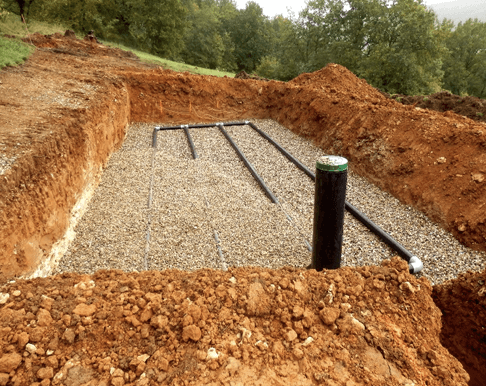
Most owners ask us which kind of basin they have. The drawing says "detention," the property manager calls it the back pond, the landscaper calls it the wet area, and the truth is usually one of five types, plus two variants you only see over the Edwards Aquifer. Here is how to tell them apart, what each one is actually built to do, and where each one earns its keep across Bexar County and the I-35 corridor.
1. Detention basins
Overview
Detention basins are designed to temporarily store stormwater runoff and release it at a controlled rate to prevent downstream flooding and erosion. Unlike retention basins, detention basins are dry between storm events. There are two types of detention basins used over the Edwards Aquifer: sand filtration and batch detention.
Sand filtration basins. This type of water-quality pond has a sand bed that filters dirty stormwater before reaching a network of perforated pipes that drain the water back into the environment.
Batch detention basins. This type uses a valve and sensor to detect when water enters the basin and opens at a set time to allow the water to settle before opening the valve.
Design and function
- Temporary storage. Holds runoff and releases it slowly through an outlet structure.
- Peak flow reduction. Cuts peak discharge rates to protect downstream water bodies.
- No permanent pool. Drains completely after a storm, which keeps mosquito breeding down.
Applications
Detention basins are commonly used in urban developments and commercial sites, where space is limited and the primary goal is peak flow attenuation. Batch detention basins are used primarily over the Edwards Aquifer.
2. Retention basins
Overview
Retention basins, also called wet ponds or permanent pools, are designed to store stormwater runoff for an extended period, providing both water storage and treatment. In contrast, batch retention basins and sand filter basins temporarily hold runoff water before it is discharged.
Design and function
- Permanent pool. Holds a standing body of water between storm events, which adds aesthetic and ecological value.
- Pollutant removal. Sedimentation drops solids out, and aquatic plants take up nutrients.
- Flood control. Larger storms are handled by the freeboard above the permanent pool.
Applications
You see retention basins on residential developments, public parks, and corporate campuses where the permanent pool doubles as an amenity and the standing water buys some incidental settling between storms.
3. Infiltration basins
Overview
Infiltration basins are designed to capture stormwater runoff and allow it to percolate into the ground, recharging the groundwater table.
Design and function
- Groundwater recharge. Water moves down through the soil column rather than off-site, cutting runoff volume.
- Pollutant filtration. The soil layers strip pollutants as water passes through them.
- No outlet structure. Water leaves the basin almost entirely by infiltration, not by pipe.
Applications
Infiltration basins are most effective in areas with permeable soils and low groundwater tables, commonly used in suburban and rural developments. Mostly found east of I-35.
4. Bioretention basins
Overview
Bioretention basins, also known as rain gardens or bio-swales, are landscaped depressions designed to capture, filter, and treat stormwater runoff using soil, vegetation, and microbial activity.
Design and function
- Multi-stage treatment. Pretreatment (a sediment forebay), filtration through engineered soil, and vegetation uptake.
- Pollutant removal. Sediments, nutrients, heavy metals, and hydrocarbons all come out as water passes through the system.
- Doubles as landscape. When designed and planted, the basin reads as a planted feature rather than infrastructure.
Applications
Bioretention basins are popular in urban areas, parking lots, and streetscapes, providing both functional stormwater management and landscape enhancement.
5. Constructed wetlands
Overview
Constructed wetlands are engineered systems that mimic natural wetlands to treat and manage stormwater runoff through sedimentation, filtration, and biological uptake.
Design and function
- Multi-cell design. Multiple cells or zones, each tuned to a different treatment process.
- Pollutant removal. High removal rates on nutrients, sediments, and pathogens.
- Habitat creation. Supports a mix of aquatic and terrestrial wildlife.
Applications
Constructed wetlands are suitable for large-scale developments, industrial sites, and agricultural areas where water-quality improvement is a primary objective.
A note on sand-filter maintenance
Regular maintenance is what keeps a sand filter performing. Skip it and the media plugs, the underdrain backs up, and the basin starts holding water it was meant to filter out. Sand-filter BMPs should be inspected quarterly, and after large storms, for the first year of operation. The point of the close monitoring in year one is to learn how the specific filter behaves under local rainfall before you stretch the interval. After that, semi-annual inspections are usually enough unless conditions warrant otherwise.
How the type on your property affects maintenance
The basin type on your site was picked by a civil engineer years ago to handle a specific storm calculation and a specific water-quality target. Whatever the type, the basin only does its job for as long as it holds its design volume, and that means inspection, sediment management, and structural repair on a schedule the original drawing already implied. If you cannot find the drawing, that is the first thing to track down; the second is the O&M manual that came with it. Both should be in the property's compliance file. If neither is, you are maintaining a basin without knowing what it was meant to do, and that is the most common reason a basin we walk has already lost a third of its design volume.
Need help with stormwater compliance on a San Antonio property? We do site walks at no charge.
Request a fixed-price quoteMore field notes from the watershed.
 Maintenance · 6 min
Stormwater basin maintenance in San Antonio: what it covers, what neglect costs
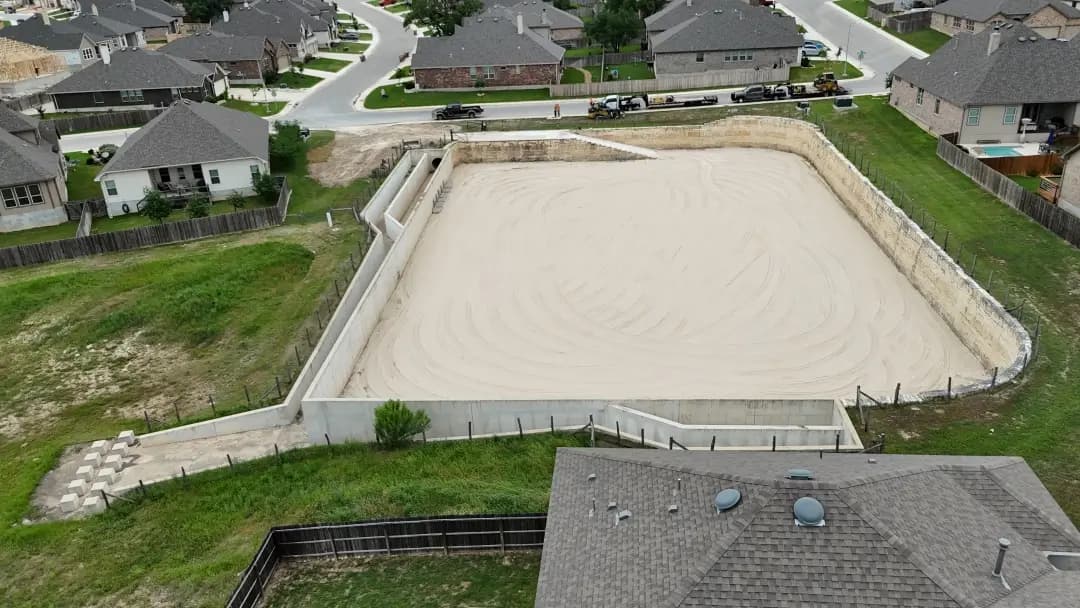
Detention ponds fail quietly. Vegetation thins, inlets clog, walls start to slump, and the first sign is usually water in a parking lot. Here's what basin maintenance covers in San Antonio, how to spot trouble early, and what a neglected pond costs to rebuild.
 Compliance · 5 min
You got a stormwater NOV in San Antonio. Here's the 30-day response.
The 30-day clock on a stormwater NOV starts the day the city issues it, not the day you decide to deal with it. What the notice means, the three things that usually trigger one, and how to put together a response the inspector will accept.
Get a stormwater
compliance quote.
Free site walk, written scope of work, fixed-price quote. Usually back to you within 48 hours.