
San Antonio, Bexar County, and Edwards Aquifer Stormwater Rules
A San Antonio construction site can sit under five separate stormwater authorities at once: TCEQ for the state permit, TCEQ's Edwards Aquifer Protection Program for the aquifer overlay, SAWS and the City of San Antonio inside city limits, and Bexar County Public Works in the unincorporated area
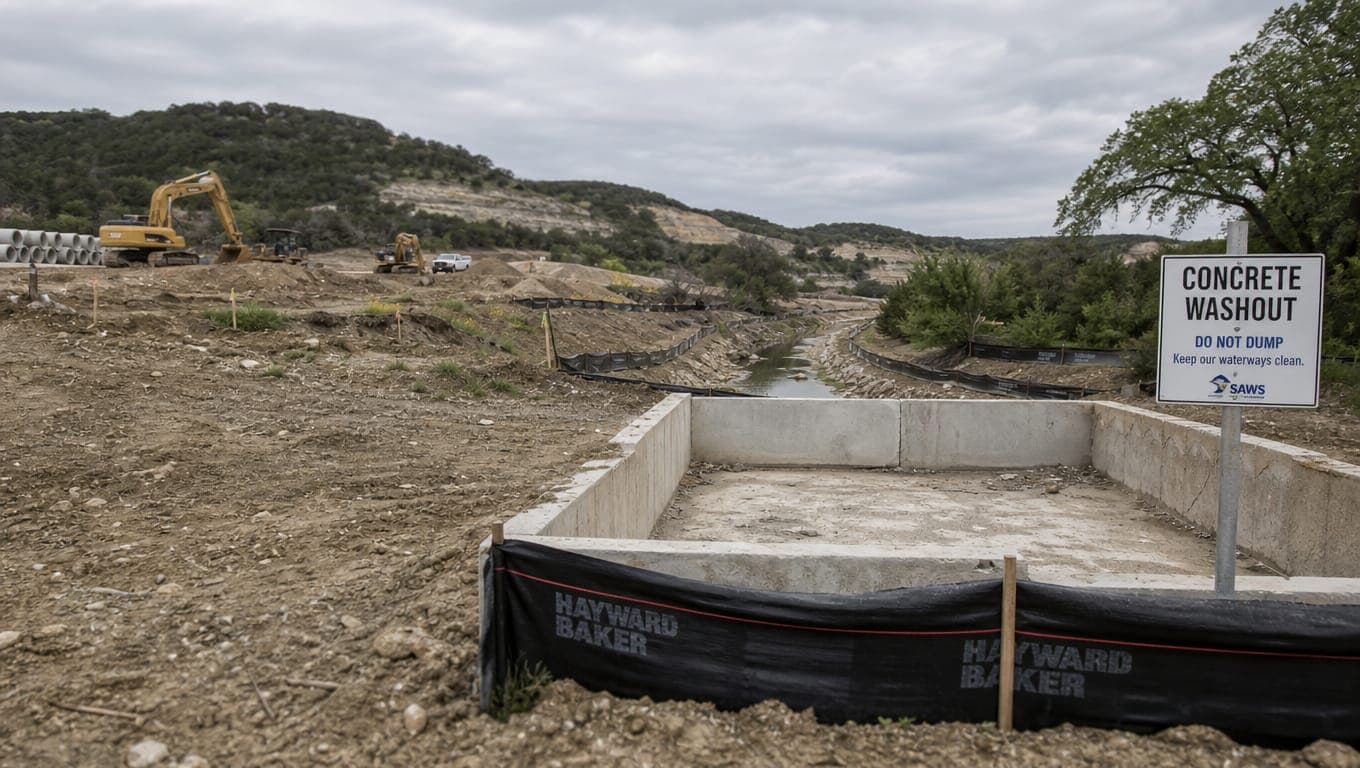
Published September 17, 2026. Last reviewed September 17, 2026. Technical review: Jim Price, CISEC, CESSWI. Founder, Stormwater Compliant LLC. 21 years working under every one of these jurisdictions.
A San Antonio construction site can sit under five separate stormwater authorities at once: TCEQ for the state permit, TCEQ's Edwards Aquifer Protection Program for the aquifer overlay, SAWS and the City of San Antonio inside city limits, and Bexar County Public Works in the unincorporated area. Each has its own requirements, timelines, and filings.
Most guidance treats "a stormwater permit" as one thing. In this metro it is four or five things, and the order you do them in determines whether you break ground on schedule.
The Five Authorities That May Control Your Site
| Authority | What it controls | What you file | When |
|---|---|---|---|
| TCEQ, stormwater program | The state construction permit, TXR150000 | SWP3, Notice of Intent for 5+ acres, Notice of Termination | Before ground disturbance, through close-out |
| TCEQ, Edwards Aquifer Protection Program | Water quality protection over the aquifer, under 30 TAC Chapter 213 | Water Pollution Abatement Plan or Contributing Zone Plan | Approved before construction may commence |
| SAWS, as co-permittee with the City and TxDOT | Local enforcement of TPDES requirements, and Recharge Zone inspections | Copy of NOI or Construction Site Notice | At least 48 hours before construction-related activities begin |
| City of San Antonio | Site design and drainage under UDC 35-504, and Chapter 34 of the City Code | Drainage and detention design through development review | During platting and permitting |
| Bexar County Public Works | Post-construction stormwater controls in the unincorporated county | Post-construction storm water control measure permit | Pre-construction and post-construction review, then annually |
Two more bodies appear in this space without regulating your construction stormwater directly. The San Antonio River Authority administers the BMP maintenance certification that Bexar County accepts, and runs the region's Low Impact Development program. TxDOT is a co-permittee on the MS4 and controls work in state right of way.
TCEQ and the Edwards Aquifer Authority Are Not the Same Thing
This confusion costs people time every week, so it is worth being blunt.
The Edwards Aquifer Authority (EAA) regulates groundwater use. Pumping, well permits, and withdrawal rights across portions of eight counties: Bexar, Comal, Hays, Caldwell, Guadalupe, Medina, Uvalde, and Kinney. If you are drilling a well or drawing water, the EAA is your agency.
TCEQ's Edwards Aquifer Protection Program regulates water quality and construction activity over the aquifer, under 30 TAC Chapter 213. If you are building something on the Recharge, Transition, or Contributing Zone, this is your agency.
For a construction project, it is TCEQ, not the EAA. Calling the Edwards Aquifer Authority about your detention basin design will get you a polite redirection and cost you a day.
Where You Are Determines What Applies
Three overlapping geographies decide your obligations, and they do not share boundaries.
Inside or outside the City of San Antonio. Inside the city limits, the UDC governs site design and drainage, and SAWS enforces stormwater as co-permittee. In the unincorporated county, Bexar County Public Works governs, and the post-construction permit applies. The city's ETJ complicates this further, and annexation history means adjacent parcels sometimes fall differently.
Which Edwards Aquifer zone, if any. The Recharge Zone is where the aquifer's formations crop out and water enters directly through caves, sinkholes, faults, and fractures. The Transition Zone sits downgradient. The Contributing Zone is upstream catchment that drains toward the recharge area. Each carries different requirements. TCEQ publishes an Edwards Aquifer Map Viewer, and the zone boundary is a mapped line, not a judgment call.
Which watershed and receiving water. This determines your outfall, your MS4 operator, and whether you discharge to an impaired segment.
A single site can be inside city limits, over the Recharge Zone, and draining to an impaired segment. That site has more requirements than a county site over the Contributing Zone, and there is no way to know which you have without checking the address against all three.
That check is free from us. Send the address.
The Edwards Aquifer Overlay Sets Your Schedule
If you take one thing from this page, take this.
Under Part II.C.5 of the state construction permit, at a site regulated under 30 TAC Chapter 213, commencement of construction may not begin until the appropriate Edwards Aquifer Protection Plan has been approved by TCEQ's Edwards Aquifer Protection Program.
That is independent of your TXR150000 coverage. You can hold a valid NOI, a complete SWP3, and a posted site notice, and still be barred from breaking ground.
Two plan types:
- Water Pollution Abatement Plan (WPAP) for regulated activity over the Recharge Zone
- Contributing Zone Plan (CZP) for regulated activity over the Contributing Zone disturbing five or more acres
Regulated activities and their exclusions are listed at 30 TAC 213.3(28) and 213.22(6).
The timeline is the problem. Under 30 TAC 213.4(e), administrative review runs up to 30 days, and technical review of an administratively complete application runs 90 days. That is up to 120 days before you can start, and the clock only begins when the application is administratively complete. An incomplete submittal restarts the front end.
Developers who discover this during permitting lose a quarter. Developers who plan for it lose nothing. It is the single most schedule-relevant fact in this market and it is absent from every national SWPPP guide.
TCEQ's San Antonio Regional Office covers Comal, Bexar, Medina, Uvalde, and Kinney counties and can be reached at (210) 490-3096.
Full detail in Edwards Aquifer Protection Plans: WPAP and CZP basics.
What SAWS Requires
San Antonio Water System enforces TPDES requirements locally as co-permittee with the City of San Antonio and TxDOT, under the construction stormwater ordinance 2014-06-19-0472, approved by City Council June 19, 2014.
What that means in practice:
Notification at least 48 hours before you start. A copy of your NOI or Construction Site Notice goes to stormwaterconstruction@saws.org at least 48 hours before construction-related activities begin. Two minutes of work, missed constantly, especially by contractors arriving from other Texas markets. See the 48-hour SAWS notification requirement.
A certified SWPPP and the permit posted on site. The ordinance requires the plan and the posted TPDES permit, and it requires certified stormwater inspectors producing inspection reports.
Recharge Zone inspections. SAWS inspects quarterly over the Recharge Zone within COSA jurisdiction to verify compliance with the approved WPAP. That is a separate inspection regime from your construction inspections, checking different things. See the SAWS construction stormwater ordinance.
SAWS also runs an Aquifer Protection and Evaluation program on the water-supply side, which is why they take Recharge Zone work seriously. This is their drinking water source.
More in the SAWS construction stormwater ordinance.
What the City of San Antonio Requires
Inside the city limits, two instruments matter.
Chapter 34 of the City Code references the TCEQ construction general permit, so local construction requirements stay consistent with the state permit rather than diverging from it. That is helpful: the city is not inventing a parallel construction standard.
UDC Section 35-504, Stormwater Management, governs site design. This is where detention sizing, drainage, and the regional program alternative live. Key structural provisions:
- Projects increasing impervious area by more than 0.1 acres must provide detention, unless they participate in the Regional Stormwater Management Program (RSWMP), which allows a fee in lieu of on-site detention where eligible.
- Maximum outflow from a detention facility is restricted to the undeveloped or existing-development flow rate for the 5-year, 25-year, and 100-year frequencies.
- The timing of the released hydrograph must be checked against flow in the first open watercourse, to avoid increasing the receiving peak.
- In-line basins on an existing watercourse must not raise flood elevations upstream of the development boundary.
- On-site detention facilities must be privately owned and maintained by the property owner or community association, with a maintenance schedule submitted to the Infrastructure Services Department.
- Retention with a permanent wet pool, or pumped detention, is generally not accepted as mitigation unless the facility remains privately owned, operated, and maintained.
That last pair matters more than it reads. The city is telling you at design stage that somebody owns this basin forever. See UDC 35-504 and San Antonio site design.
What Bexar County Requires
In the unincorporated county, Bexar County Public Works runs a post-construction program that the city does not.
The trigger is one acre or more of disturbance, or under one acre if part of a larger common plan of development.
The process runs in two parts: a pre-construction review and a post-construction review, with engineer certification of the BMPs required at completion.
The fees are $250 total, being a $50 application fee plus a $200 review fee. Sites over the Edwards Aquifer holding an approved WPAP or CZP pay the $50 application fee only, with the review fee waived, on the reasoning that TCEQ has already performed a technical review.
The mitigation framework works on target impervious cover. The county publishes target percentages by land use, set equal to the limitations for Category 2 properties under City of San Antonio Ordinance 81491 concerning development over the Recharge Zone. The county is explicit that these are not limits. They are targets used to establish whether mitigation is needed. Where proposed impervious cover exceeds the composite target, the difference becomes mitigation points, which you earn back through structural and non-structural BMPs. Fee-in-lieu participation is capped at 50% of required mitigation points.
And it does not end at completion. The permit carries recurring obligations, including a maintenance provider holding a certification that Bexar County accepts, currently issued through the San Antonio River Authority.
See Bexar County post-construction permits and Bexar County target impervious cover.
The Order of Operations
Sequence matters more than any individual requirement. This is the order that keeps projects on schedule.
- Determine your jurisdictions. Address against city limits, ETJ, county, and Edwards Aquifer zones. Do this at feasibility, not at permitting.
- If over the Recharge or Contributing Zone, start the Edwards Aquifer plan immediately. Up to 120 days of review under 30 TAC 213.4(e). Everything else fits inside that window.
- Commission the geologic assessment if you are over the Recharge Zone. Sensitive features found late change your design.
- Design to the applicable site standard. UDC 35-504 inside the city, county criteria outside.
- Obtain Edwards Aquifer plan approval. Construction cannot commence before this.
- Prepare the SWP3 and confirm your disturbed acreage tier.
- File the NOI through STEERS if five acres or more, before construction begins.
- Notify SAWS at least 48 hours before construction-related activities begin.
- Post the site notice, with the NOI first page for large construction.
- Build, inspect, and document on the permit schedule.
- Reach final stabilization, then file the Notice of Termination within 30 days.
- Close out the post-construction permit in unincorporated Bexar County, with engineer certification, and start the recurring maintenance obligations.
Steps 2 and 5 are the ones that move completion dates. Everything else is schedulable.
The state permit side of this sequence is covered in our field guide to the TCEQ Construction General Permit.
After Construction: What Does Not End
Three obligations survive your last day on site.
The permanent BMPs. Whatever basin, vault, or filter your design required is now a maintained asset with a perpetual obligation attached. In unincorporated Bexar County that obligation is formalized in the post-construction permit, including a certified maintenance provider.
The Edwards Aquifer plan conditions. An approved WPAP carries BMP and maintenance requirements that continue after construction, in addition to the construction permit's requirements. SAWS inspects for this.
The UDC maintenance commitment. On-site detention inside the city is privately owned and maintained, with a maintenance schedule on file.
Owners buying developed commercial property in this region inherit all three, usually without being told. That is worth a due diligence line item.
A Note on Conflicting Published Figures
A caution, because this cluster is only worth reading if it is accurate.
Several widely circulated summaries of San Antonio water-quality volume and detention drawdown requirements trace back to City of Austin criteria rather than San Antonio's. Austin and San Antonio both regulate over the Edwards Aquifer and their documents look similar, so the numbers travel. They do not transfer.
There is a related wrinkle worth knowing: TCEQ's own technical guidance manual, RG-348, credits its clay liner specification table to City of Austin 2004 criteria. In that case the adoption is deliberate and the specification genuinely applies, because TCEQ published it. The problem is only when someone lifts an Austin figure that TCEQ and San Antonio never adopted.
So: for water quality volume and drawdown provisions inside the city, confirm against the codified UDC on the City's MuniCode site rather than any secondary summary, including ours. We publish the structural provisions above because we verified them; we are not publishing specific volume or drawdown figures we could not confirm against the live code.
If you need that answered for a specific site, ask us and we will pull the current code section rather than guess.
The Complete Local Rules Index
Every jurisdiction and overlay, covered properly.
Understanding the landscape
- Who Regulates Stormwater in San Antonio? A Jurisdiction Map - the definitive breakdown of who controls what, and where the boundaries fall
SAWS and the City
- The SAWS Construction Stormwater Ordinance (2014-06-19-0472) - what the ordinance requires and how SAWS enforces it
- The 48-Hour SAWS Notification Requirement - short, high-utility, and frequently missed
- UDC 35-504 and San Antonio Site Design - detention sizing, the regional program, and drainage easements
- Responding to a SAWS Stop-Work Order - the fastest documented path back to vertical
The Edwards Aquifer
- Edwards Aquifer Protection Plans: WPAP and CZP Basics - what TCEQ actually approves, and why it is not your SWPPP
- Basin Lining Requirements Over the Recharge Zone - RG-348 liner specifications, in detail
- Karst Features and Cave Protection Requirements - geologic assessments, sensitive features, and buffer design
Bexar County
- Bexar County Post-Construction Permits: The Two-Part Process - triggers, fees, reviews, and engineer certification
- Bexar County Target Impervious Cover, Explained - what the targets are, and why they are not limits
Tell Us the Address
This is the offer, and it costs you nothing.
Send us the project address. We will tell you which jurisdictions apply to that specific parcel, whether it sits over the Recharge, Transition, or Contributing Zone, what each authority requires, and in what order you need to do it. If a 120-day Edwards Aquifer review is sitting in your critical path, you will know this week rather than in three months.
If you want the work done as well, we will follow with a written scope and a fixed price, typically inside 48 hours.
Request a quote or call (210) 776-6515. See our SWPPP services and post-construction stormwater programs.
Sources
- TCEQ, Edwards Aquifer Protection Program
- TCEQ, Edwards Aquifer Rules and Technical Guidance
- TCEQ, Edwards Aquifer Protection Plans
- TCEQ, Stormwater Permits and the Edwards Aquifer
- TCEQ, 2023 Construction General Permit TXR150000 (PDF)
- SAWS, Aquifer Protection and Evaluation
- Bexar County, Post-Construction Permits
- Bexar County, Water Quality and Maintenance Manual (PDF)
- City of San Antonio, 2022 Stormwater Management Plan, TPDES Permit WQ0004284000 (PDF)
Common questions
- Who regulates stormwater in San Antonio?
- TCEQ for the state construction permit and the Edwards Aquifer overlay, SAWS and the City of San Antonio inside city limits, and Bexar County Public Works in the unincorporated county. TxDOT is a co-permittee, and the San Antonio River Authority administers BMP maintenance certification.
- Do I need an Edwards Aquifer permit?
- If your regulated activity is over the Recharge, Transition, or Contributing Zone, you need an approved Water Pollution Abatement Plan or Contributing Zone Plan before construction may commence.
- Is the Edwards Aquifer Authority the same as TCEQ?
- No. The EAA regulates groundwater use and pumping. TCEQ regulates water quality and construction over the aquifer. For a construction project, it is TCEQ.
- Does a SWPPP cover the Edwards Aquifer requirement?
- No. They are separate reviews under separate rules, and Part II.C.5 of the state permit bars commencement until the aquifer plan is approved.
- How long does Edwards Aquifer review take?
- Up to 30 days administrative plus 90 days technical for an administratively complete application, under 30 TAC 213.4(e).
- What is different in unincorporated Bexar County?
- The county's post-construction storm water control measure permit applies, with a two-part review, engineer certification at completion, and recurring obligations afterward.
- What does SAWS want, and when?
- A copy of your NOI or Construction Site Notice at stormwaterconstruction@saws.org at least 48 hours before construction-related activities begin.
The work behind this article
- Stormwater Pollution Prevention Plan
Site-specific Stormwater Pollution Prevention Plans for Bexar County construction, written to the TCEQ Construction General Permit (TXR150000) and built so your superintendent will actually open the binder.
- Post-Construction Stormwater
An annual program that keeps your basins, vaults, and conveyance systems documented, inspected, and in regulatory good standing.
- 40-Point Stormwater Inspection
One inspector, one tablet, 40 checkpoints. You get the report before our truck leaves the property.
Need help with stormwater compliance on a San Antonio property? We do site walks at no charge.
Request a fixed-price quoteMore field notes from the watershed.
 Compliance · 6 min
What the 2028 TXR150000 Renewal Could Change
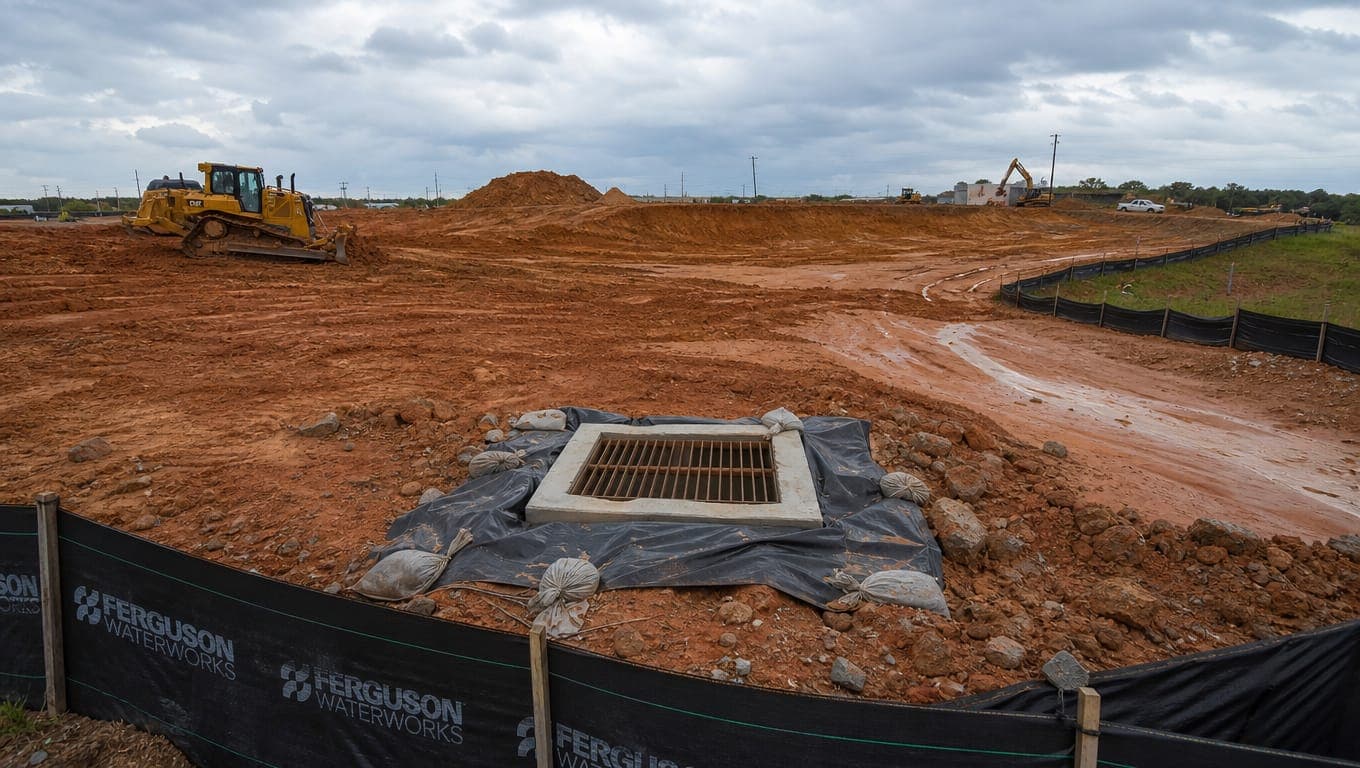
The current TCEQ Construction General Permit, TXR150000, expires March 5, 2028. TCEQ opened the renewal process in 2026 and held a hybrid stakeholder meeting on June 9, 2026 at the Park 35 campus, where preliminary proposed modifications were presented. Informal comments go to SWGP@tceq.texas.gov.
 Field guide · 8 min
The Most Common SWPPP Violations on San Antonio Job Sites
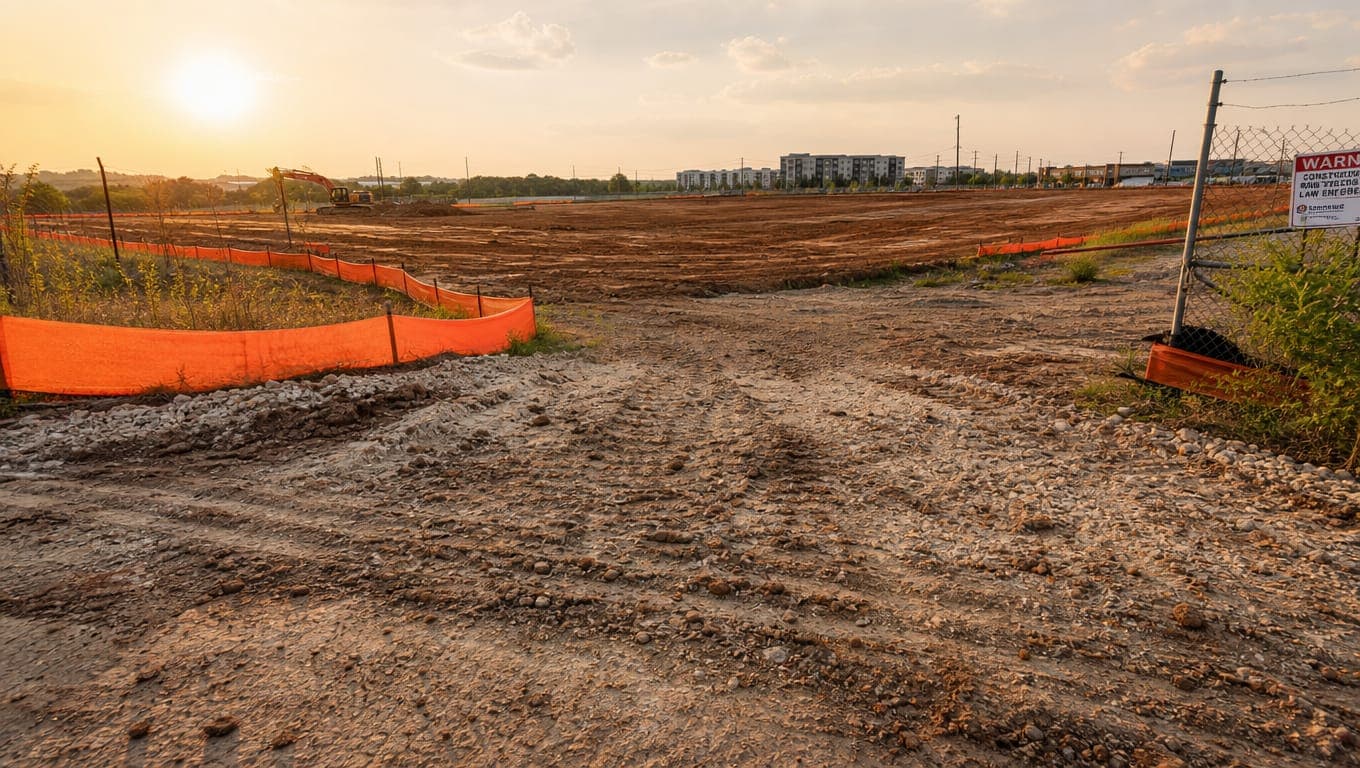
The violations we write most often are not exotic. They cluster in two groups: documentation that was never completed, and controls that were installed incorrectly rather than not installed at all. Roughly half of what gets cited on a well-run site is paperwork, which is the part contractors
Get a stormwater
compliance quote.
Free site walk, written scope of work, fixed-price quote. Usually back to you within 48 hours.