
Texas SWPPP Requirements: A Field Guide to the TCEQ Construction General Permit
If your project will disturb one acre or more of soil in Texas, you need coverage under the TCEQ Construction General Permit, TXR150000, and a Stormwater Pollution Prevention Plan in place before construction begins. Sites of five acres or more must also file a Notice of Intent. Smaller sites
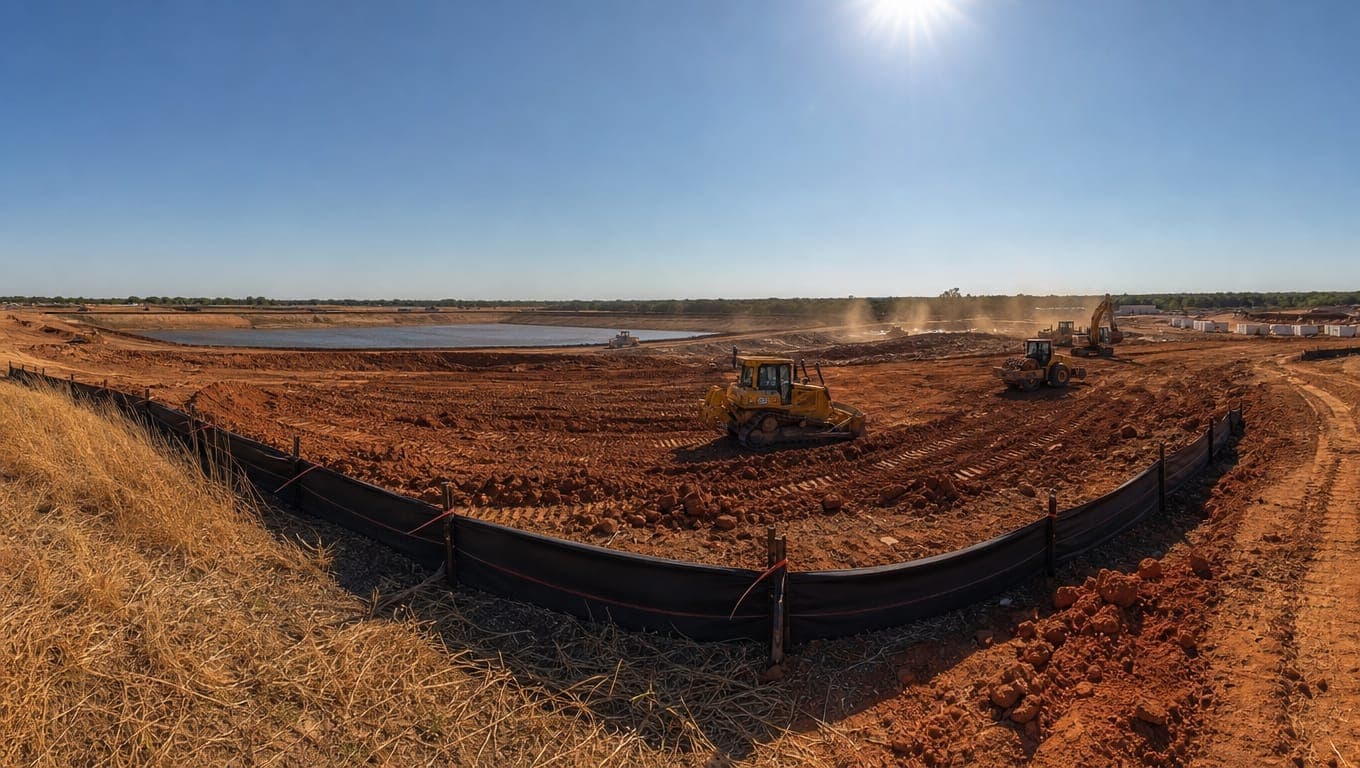
Published August 5, 2026. Last reviewed August 5, 2026. Technical review: Jim Price, CISEC, CESSWI. Founder, Stormwater Compliant LLC. 21 years inspecting and repairing stormwater controls in the San Antonio metro.
If your project will disturb one acre or more of soil in Texas, you need coverage under the TCEQ Construction General Permit, TXR150000, and a Stormwater Pollution Prevention Plan in place before construction begins. Sites of five acres or more must also file a Notice of Intent. Smaller sites inside a larger development are still regulated.
That is the short version. The rest of this page is the long version, because almost every part of that sentence has a qualifier attached to it, and the qualifiers are where projects get shut down.
We inspect these sites for a living. What follows is the permit as it actually gets enforced, with the section numbers so you can check us. Each section links to a dedicated article that goes deeper.
What the TCEQ Construction General Permit actually is
Texas runs its own delegated version of the federal Clean Water Act stormwater program, called TPDES. That means for construction in Texas, your permitting authority is the Texas Commission on Environmental Quality, not the EPA. People get this wrong constantly and go looking for federal forms that do not apply to them.
The permit itself is TXR150000, usually called the Construction General Permit or just the CGP. The current version took effect March 5, 2023 and expires March 5, 2028. It is a general permit, which means you do not negotiate individual terms. You either qualify for coverage and accept the conditions, or you apply for an individual permit, which almost nobody does.
The document you have to produce and maintain is the Stormwater Pollution Prevention Plan. TCEQ calls it the SWP3 in its own paperwork. The rest of the industry says SWPPP. They are the same thing, and we use both here because you will encounter both.
One thing worth being clear about up front: the SWPPP is not a filing. For most sites you never send it anywhere. It lives on the job site, it gets updated as conditions change, and it is the first thing an inspector asks to see. A plan that sits in a binder in the office, unchanged since the day it was written, is a plan that will fail an inspection even if every control on the ground is perfect.
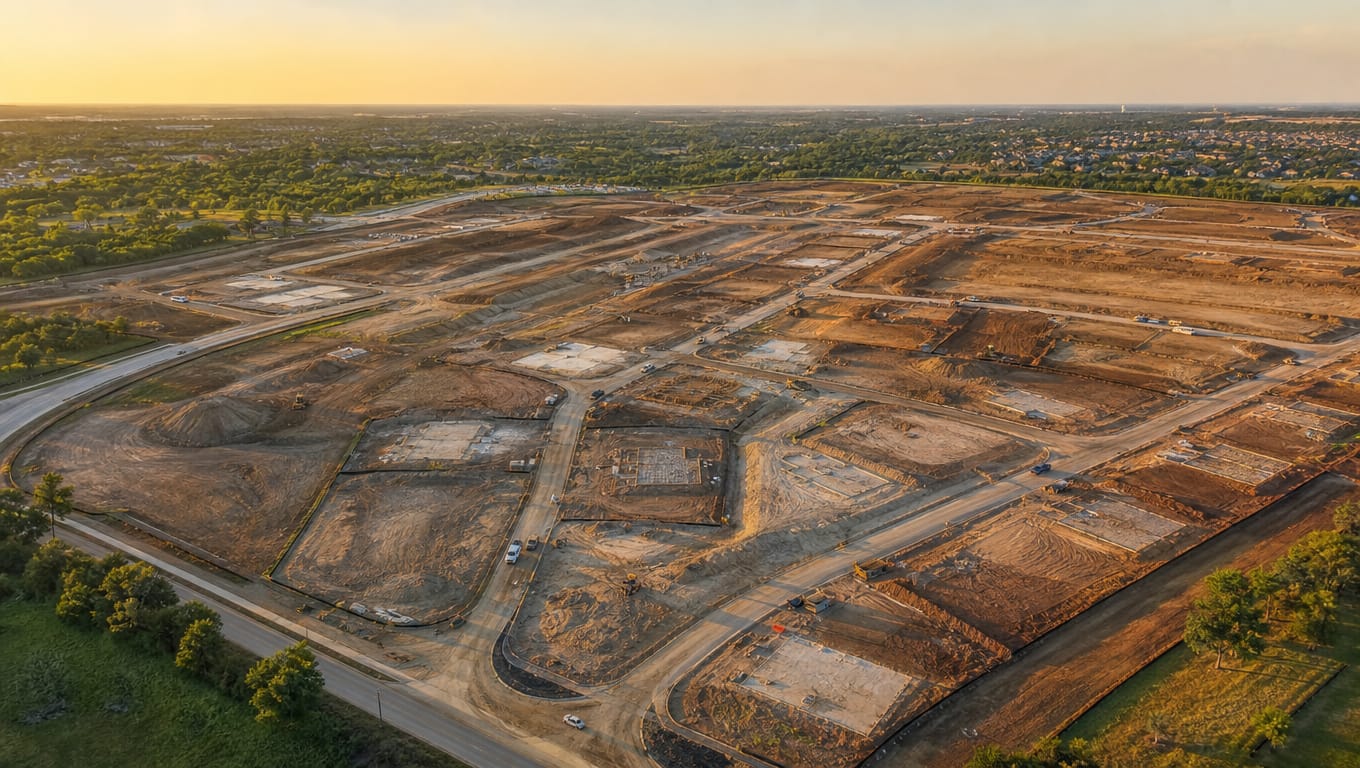
Do you need a SWPPP? The acreage triggers
The one-acre rule
Construction activity is regulated under the CGP when it discharges stormwater to surface water in the state and disturbs one acre or more of soil. Below one acre, and not part of anything larger, you are outside the permit.
"Disturbs" means soil disturbance, not building footprint. Clearing, grading, excavation, stockpiling, and haul roads all count. We have watched contractors calculate their acreage off the slab dimensions and come up half an acre short of reality.
The larger common plan of development
This is the provision that catches people, and it is worth reading twice.
The acreage test does not look at your parcel in isolation. It looks at the larger common plan of development or sale. If your half-acre pad sits inside a 40-acre master-planned development, the development is the unit of measurement, and your half-acre pad is regulated.
The practical effect: a homebuilder framing houses on individual lots inside a subdivision is an operator under this permit, with obligations, even though no single lot approaches an acre. Most of them do not know this. It is the single most common reason we get a call from someone who just received a violation they did not see coming.
If you are working inside a subdivision, a business park, a phased commercial development, or anything with a master plat, assume you are regulated until someone shows you otherwise. Our article on when a SWPPP is required in Texas walks through the edge cases.
What you have to file, by site size
Once you are regulated, the size of the disturbance determines what you actually file. This is the distinction most online guides blur, and getting it wrong costs you either unnecessary fees or an unpermitted site.
| Small construction (1 to under 5 acres) | Large construction (5 acres and up) | |
|---|---|---|
| SWP3 required | Yes, before construction begins | Yes, before construction begins |
| Notice of Intent (NOI) | No | Yes, electronically through STEERS |
| Application fee | None | $225 electronic, $325 paper |
| Site notice | Small Construction Site Notice, TCEQ-20963, signed and posted | Large Construction Site Notice, TCEQ-20961, plus the first page of the NOI |
| Posting deadline | At least 2 days before construction begins | Before construction begins |
| Copy to MS4 operator | Yes | Yes |
| Notice of Termination (NOT) | No | Yes, within 30 days of final stabilization |
Secondary operators on large sites post TCEQ-20962 instead. There is also a rarely-used low-erosion-potential path using TCEQ-20964, which requires the project to start and finish inside a defined seasonal window and is not practical for most San Antonio work.
The site notice is the cheapest compliance item on this entire list and one of the most frequently missed. It has to be posted where the public and any inspector can read it from outside the fence, and it has to stay there until final stabilization. The ratio of consequence to effort on this one is absurd, and it turns up constantly in the most common SWPPP violations on San Antonio job sites.
For the full breakdown of the threshold, see the 1-acre vs 5-acre rule explained. For the filing itself, see filing a Notice of Intent through STEERS.
Who counts as the operator
The permit assigns obligations to the "operator," and on a real job site there is usually more than one candidate. Part I.B of the permit splits them.
Primary operator is the person or persons who either have on-site operational control over construction plans and specifications, including the ability to modify them, or have day-to-day operational control over the activities needed to comply with the SWP3. In plain terms: whoever can change the plans, and whoever can tell a crew to go fix the silt fence.
Secondary operator is typically the property owner, whose control is limited to hiring other operators such as a general contractor, or to approving and disapproving changes to plans without day-to-day on-site control.
Two consequences worth knowing:
- Secondary operators are not off the hook. They must either prepare their own SWP3 or participate in a shared SWP3 covering the areas where they control plans and specifications.
- If there is no primary operator at the site, the secondary operator is defined as the primary operator and takes on the full set of primary obligations. An owner who assumed the GC was carrying the permit, on a site where the GC never accepted that role, has just become the permittee.
On subdivisions where a developer sells finished lots to multiple homebuilders, this gets genuinely complicated, and a written division of responsibilities is the only thing that prevents an argument after the fact. We covered that scenario in multi-operator sites and who holds the liability.
What belongs in the SWP3
A compliant plan is site-specific. That phrase gets used loosely, so here is what it means concretely. Your SWP3 has to contain:
- A description of the site and the sequence of major construction activities, with total disturbed acreage
- A site map showing drainage areas, flow direction, discharge points, and receiving waters
- The erosion and sediment controls you will use, with installation and maintenance detail
- A pollutant source inventory covering materials, fueling, concrete washout, and waste
- Spill prevention and response procedures
- Your inspection schedule and the forms you will use
- A signed operator certification
- Records of every inspection, corrective action, and plan amendment, kept with the plan
The site map is the part that separates a real plan from a purchased template. It has to reflect your actual topography and drainage, and it has to evolve as the site does. The controls that protect a site during clearing are not the controls that protect it during vertical construction, and an inspector who sees a clearing-phase map on a site that is three months into framing knows exactly what they are looking at. See SWPPP site maps and BMP sequencing.
There is a related failure that costs people more than it should: installing something that works but is not what the plan says. If the SWP3 calls for silt fence and your crew installed wattles, that is a violation even if the wattles are performing better. The plan is a living document and you are allowed to amend it. You are not allowed to ignore it. More on this in SWPPP site maps and BMP sequencing.
How often you have to inspect
The default schedule under Part III.F.8(c)i is:
At least once every fourteen (14) calendar days, and within 24 hours of the end of a storm event of 0.5 inches or greater.
A few mechanics that matter in practice:
- Multiple small storms that together produce 0.5 inches within a 24-hour period trigger the inspection just as a single storm would.
- If the 24-hour window falls entirely outside normal working hours, you have until the end of the next business day.
- For a multi-day storm producing 0.5 inches or more on the first day and continuing, you owe two inspections, not one per day: one within 24 hours of the first day, one within 24 hours after the last qualifying day.
The permit also allows an elective alternative under Part III.F.8(c)v: inspect at least once every seven calendar days, and the inspection happens regardless of whether it rained. Many contractors prefer this because it is a fixed calendar item rather than a weather-triggered scramble. If you choose it, it has to be documented in the SWP3.
Four situations change the frequency:
| Condition | Frequency |
|---|---|
| Areas that have reached final or temporary stabilization | At least once per month |
| Frozen conditions where runoff is unlikely | At least once per month until thawing begins |
| Arid, semi-arid, or drought-stricken areas | At least once per month, plus within 24 hours after a 0.5-inch storm |
| Long, narrow linear sites (pipeline, utility) | 14-day and post-storm schedule, but representative inspections permitted |
For linear projects, representative inspection means walking controls for 0.25 mile above and below each access point, and treating those conditions as representative of the reach between inspected segments.
One trap: you cannot switch schedules whenever it suits you. Changes are limited to once per calendar month, must be implemented within the first five business days of the month, and the reason has to be documented in the SWP3. Full detail in how often SWPPP inspections are required in Texas.
Finding the problem is only half of it. The most-failed requirement we see is not the physical fix, it is documenting the fix. Sites repair the control, never write it down, and get cited again on the same item. See the most common SWPPP violations on San Antonio job sites.
Stabilization deadlines, and the myth that will not die
Correction worth making loudly: there is no 7-day stabilization deadline for impaired waters in the 2023 TXR150000. Several widely-read guides state one. It is not in the permit. Contractors have accelerated schedules and spent money chasing a deadline that does not exist.
Here is the actual language, from Part III.F.2(b)iii and restated in Part IV Section B.
Stabilization must be initiated immediately in portions of the site where construction activities have permanently ceased, or have temporarily ceased and will not resume for a period exceeding fourteen calendar days.
The permit defines "immediately" for you: as soon as practicable, but no later than the end of the next work day following the day earth-disturbing activity ceased.
Once initiated, stabilization measures must be completed as soon as practicable, but no more than fourteen calendar days after initiation.
So the structure is: next work day to start, fourteen days to finish. Exceptions exist for frozen conditions and for arid, semi-arid, and drought-stricken areas where immediate vegetative establishment is infeasible, in which case non-vegetative measures go in as soon as practicable.
That last exception matters here. San Antonio spends real portions of the year in drought designation, and the difference between "we will seed it when the rain comes" and a documented non-vegetative measure is the difference between compliance and a finding. We break the whole thing down in stabilization deadlines contractors get wrong.
Closing out: Final stabilization and the Notice of Termination
The most expensive mistake in this entire permit is not a violation. It is forgetting to close out.
Permit coverage does not end when the equipment leaves. It ends when you achieve final stabilization and file the Notice of Termination. Until the NOT is submitted and approved by TCEQ, you are still the permittee, still subject to every condition, and still accruing exposure on a site you no longer visit.
Final stabilization, per Part I.B, means all soil-disturbing activity is complete and a uniform perennial vegetative cover with a density of at least 70% of the native background vegetative cover has been established on all unpaved areas, or equivalent permanent measures such as riprap or gabions are in place. "Uniform" is defined in the permit as evenly distributed, without large bare areas.
Three alternate paths exist:
- Residential lots: the homebuilder either completes final stabilization, or establishes temporary stabilization before transferring the home and informs the buyer of the need for final stabilization. If temporary stabilization is not feasible, perimeter controls stay and the homeowner is informed. Either way, it has to be documented in the SWP3.
- Agricultural land: returning the land to preconstruction agricultural use can satisfy it, though buffer strips and non-agricultural areas still have to meet the 70% standard.
- Arid, semi-arid, and drought-stricken areas: temporary erosion control designed to function for at least three years without active maintenance, selected and installed to achieve 70% native background coverage within three years.
The NOT is due within 30 days after final stabilization is achieved on all portions of the site you are responsible for, after a transfer of operational control, or after obtaining alternative authorization. A copy goes to the operator of any MS4 receiving the discharge, and the SWP3 has to list those MS4 operators by name and address.
We find open permits on completed projects regularly, sometimes years old. See filing the Notice of Termination.
The San Antonio, Bexar County, and Edwards Aquifer overlay
Everything above is the state permit. In the San Antonio metro, three more layers sit on top of it, and the local layers are what wreck schedules.
Edwards Aquifer plan approval is a precondition to breaking ground. Under Part II.C.5, at a site regulated under 30 TAC Chapter 213, commencement of construction may not begin until the appropriate Edwards Aquifer Protection Plan has been approved by the TCEQ Edwards Aquifer Protection Program. That is independent of your CGP status. You can hold valid CGP coverage and still be barred from starting. A Water Pollution Abatement Plan applies over the Recharge Zone, a Contributing Zone Plan over the Contributing Zone, and TCEQ's own review timelines under 30 TAC 213.4(e) run up to 30 days administrative plus 90 days technical. Discover that late and you have lost a quarter.
SAWS wants notice 48 hours before you start. Under the City of San Antonio construction stormwater ordinance (2014-06-19-0472, approved June 19, 2014), SAWS enforces TPDES requirements locally as co-permittee with the City and TxDOT. A copy of your NOI or Construction Site Notice goes to stormwaterconstruction@saws.org at least 48 hours before construction-related activities begin. It takes about two minutes and it is one of the most commonly missed items in the region.
Bexar County regulates what happens after you leave. In unincorporated Bexar County, sites disturbing an acre or more, or under an acre as part of a larger common plan, need a post-construction stormwater permit. The process runs in two parts, pre-construction and post-construction review, at $50 application plus $200 review. Sites over the Edwards Aquifer with an approved WPAP or CZP pay the $50 application fee only. Engineer certification of the BMPs is required at completion.
None of this is optional and none of it is covered by a national SWPPP template. If you want to know which jurisdictions apply to a specific address, that is a question we answer for free. Just send us the address.
What the 2028 renewal could change
TXR150000 expires March 5, 2028, and TCEQ has already opened the renewal process. A hybrid stakeholder meeting was held June 9, 2026 at the Park 35 campus, where preliminary proposed modifications were presented, and informal comments are going to SWGP@tceq.texas.gov. When the new permit issues, a 90-day grace period applies for transitioning existing authorizations.
It is early, and speculating about final permit language would be irresponsible. But if you are planning multi-year projects that will still be active in 2028, this belongs on your radar now. We are tracking it in what the 2028 TXR150000 renewal could change and updating that page as drafts publish.
The complete Texas SWPPP guide index
Every part of this permit, covered properly.
Getting coverage
- When Is a SWPPP Required in Texas? - the 1-acre trigger and the common-plan rule that catches sub-acre lots
- The 1-Acre vs. 5-Acre Rule, Explained - what changes at five acres, filing by filing
- TXR150000 Explained for Texas Contractors - the permit's structure in plain language
- Filing a Notice of Intent Through STEERS, Step by Step - the electronic filing walkthrough
Building the plan
- SWPPP Site Maps and BMP Sequencing - what a compliant map contains and how it evolves
- Multi-Operator Sites: Who Holds the Liability? - developers, homebuilders, and written divisions of responsibility
Staying compliant
- How Often Are SWPPP Inspections Required in Texas? - every schedule option in the permit
- Stabilization Deadlines Contractors Get Wrong - and the 7-day myth, corrected
- The Most Common SWPPP Violations on San Antonio Job Sites - from our own inspection records
Closing out and costs
- Filing the Notice of Termination - final stabilization and ending liability
- What the 2028 TXR150000 Renewal Could Change - tracking the renewal as it develops
Send us the drawings
If you have a project in San Antonio, Bexar County, Boerne, New Braunfels, or Seguin and you want to know exactly what it will require, send us the civil drawings. We will come back with a fixed-price SWPPP scope and a timeline, including which jurisdictions apply to that specific address and what each one wants.
No hourly meter, no discovery call. A written scope, typically inside 48 hours.
Request a quote or call (210) 776-6515.
We have been writing these plans and fixing the controls behind them in this market since 2005. The plan a regulator reads should match the work a crew actually performs, which is easier to guarantee when the same firm does both. More about our SWPPP services.
Sources
Common questions
- Do I need a SWPPP for a project under one acre?
- Not on its own. But if the project is part of a larger common plan of development or sale that totals one acre or more, it is regulated regardless of your individual footprint. Subdivision lots are the classic example.
- Do I have to send my SWPPP to TCEQ?
- No. The SWP3 stays on site. What gets filed for large construction is the Notice of Intent, electronically through STEERS. Small construction sites file nothing, but must post a signed Construction Site Notice.
- What does the NOI cost?
- $225 filed electronically through STEERS, $325 on paper. New STEERS accounts start in probationary status pending a signed electronic signature agreement, so do not leave the account setup until the week you need to file.
- Can my superintendent do the inspections?
- The permit does not require a third party. In practice, the inspection record is what gets audited, and self-inspection records are the thing that most often falls apart under review. That is a judgment call about risk, not a legal prohibition.
- When does my permit liability actually end?
- When final stabilization is achieved and the Notice of Termination is submitted and approved by TCEQ. Not when the crew demobilizes.
- Does a SWPPP satisfy the Edwards Aquifer requirement?
- No. They are separate reviews under separate rules. A Water Pollution Abatement Plan or Contributing Zone Plan is approved by TCEQ's Edwards Aquifer Protection Program, and under Part II.C.5 construction cannot commence until that approval is in hand.
In this series
- What the 2028 TXR150000 Renewal Could Change
The current TCEQ Construction General Permit, TXR150000, expires March 5, 2028. TCEQ opened the renewal process in 2026 and held a hybrid stakeholder meeting on June 9, 2026 at the Park 35 campus, where preliminary proposed modifications were presented. Informal comments go to SWGP@tceq.texas.gov.
- The Most Common SWPPP Violations on San Antonio Job Sites
The violations we write most often are not exotic. They cluster in two groups: documentation that was never completed, and controls that were installed incorrectly rather than not installed at all. Roughly half of what gets cited on a well-run site is paperwork, which is the part contractors
- Filing the Notice of Termination
A Notice of Termination must be filed within 30 days after final stabilization is achieved, operational control is transferred, or alternative authorization is obtained. Final stabilization generally means uniform perennial vegetative cover at 70% of native background density. Permit coverage
- Multi-Operator Sites: Who Holds the Liability?
TXR150000 assigns liability to "operators," and a site can have several at once. Primary operators control construction plans or day-to-day compliance activity. Secondary operators, usually owners, hire others or approve plan changes without on-site control. If no primary operator exists at a
- SWPPP Site Maps and BMP Sequencing
A compliant SWPPP site map shows your actual drainage areas, flow directions, discharge points, receiving waters, and the location of every control, tied to a construction sequence that describes when each control goes in and comes out. A map that does not change as the site changes is the most
- Stabilization Deadlines Contractors Get Wrong
Under TXR150000, stabilization must be initiated immediately, meaning no later than the end of the next work day, wherever earth-disturbing activity has permanently ceased or has temporarily ceased and will not resume within 14 calendar days. Once initiated, it must be completed within 14 calendar
- How Often Are SWPPP Inspections Required in Texas?
Texas construction sites must be inspected at least once every 14 calendar days and within 24 hours of the end of a storm event of 0.5 inches or greater. The permit also allows an elective schedule of once every 7 calendar days regardless of rainfall, plus reduced monthly frequencies for
- Filing a Notice of Intent Through STEERS, Step by Step
Texas construction sites disturbing five acres or more must file a Notice of Intent with TCEQ before construction begins, submitted electronically through STEERS. The fee is $225 electronic, $325 on paper. The filing itself takes under an hour. Getting the STEERS account authorized to submit it
- TXR150000 Explained for Texas Contractors
TXR150000 is the TCEQ Construction General Permit, the statewide authorization that lets Texas construction sites discharge stormwater legally. The current version took effect March 5, 2023 and expires March 5, 2028. It applies to sites disturbing one acre or more, and it is the document that
- The 1-Acre vs. 5-Acre SWPPP Rule, Explained
Texas construction sites disturbing 1 to under 5 acres are "small construction activity": they need a SWP3 and a posted Small Construction Site Notice, but no Notice of Intent and no fee. Sites of 5 acres or more are "large construction activity" and must also file an electronic NOI ($225) and a
- When Is a SWPPP Required in Texas?
A SWPPP is required in Texas whenever construction disturbs one acre or more of soil and discharges stormwater to surface water in the state. Projects under one acre are also regulated if they are part of a larger common plan of development or sale. The plan must be in place before construction
The work behind this article
- Stormwater Pollution Prevention Plan (SWPPP)
A San Antonio SWPPP company that writes the plan, files the NOI, and walks the binder with your superintendent. Site-specific to your grading plan, written to TXR150000, not a template with somebody else's logo taken off.
- Post-Construction Stormwater
An annual program that keeps your basins, vaults, and conveyance systems documented, inspected, and in regulatory good standing.
- Stormwater Inspection Services
CISEC and CESSWI inspectors, on your site every seven days while the job is live and on your MS4's schedule once it is not. One inspector, one tablet, forty checkpoints, and the report before the truck leaves the property.
Need help with stormwater compliance on a San Antonio property? We do site walks at no charge.
Request a fixed-price quoteMore field notes from the watershed.
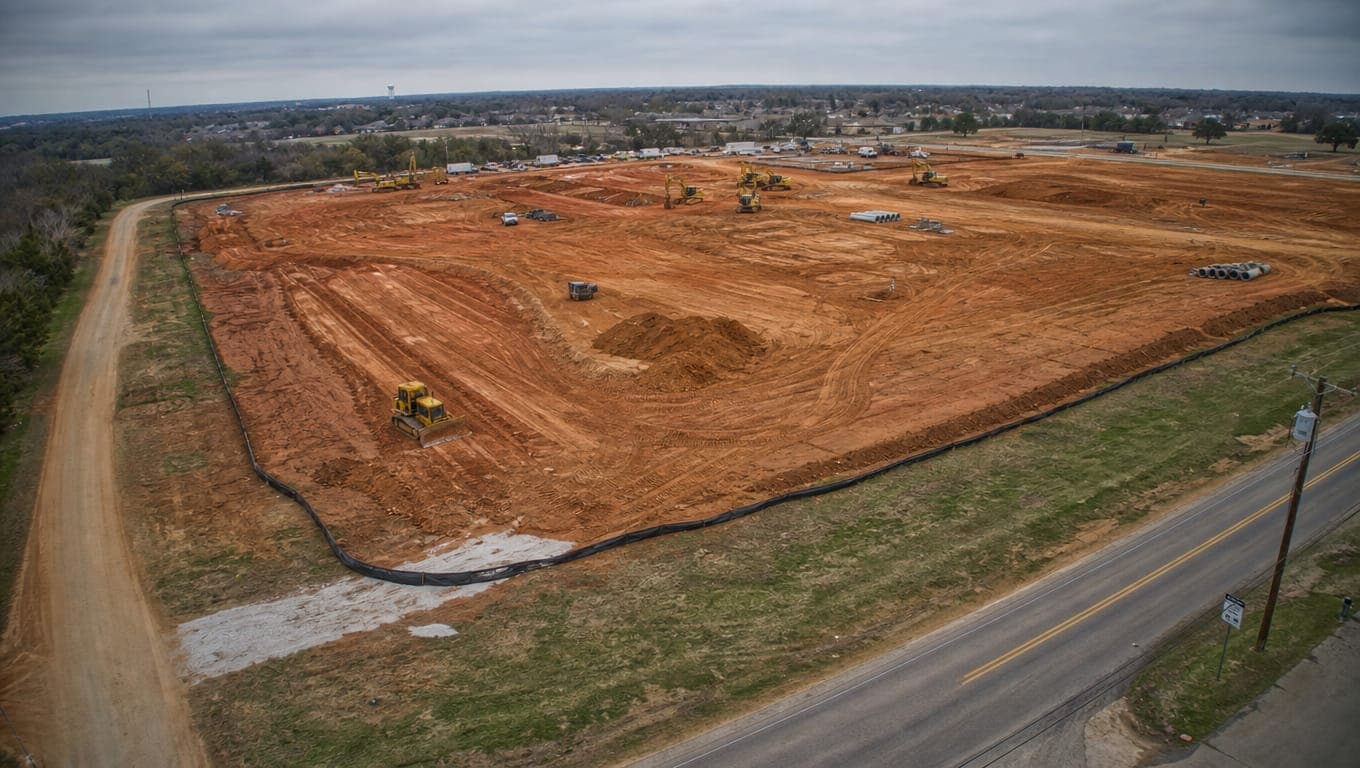 Compliance · 7 min
Filing a Notice of Intent Through STEERS, Step by Step
Texas construction sites disturbing five acres or more must file a Notice of Intent with TCEQ before construction begins, submitted electronically through STEERS. The fee is $225 electronic, $325 on paper. The filing itself takes under an hour. Getting the STEERS account authorized to submit it
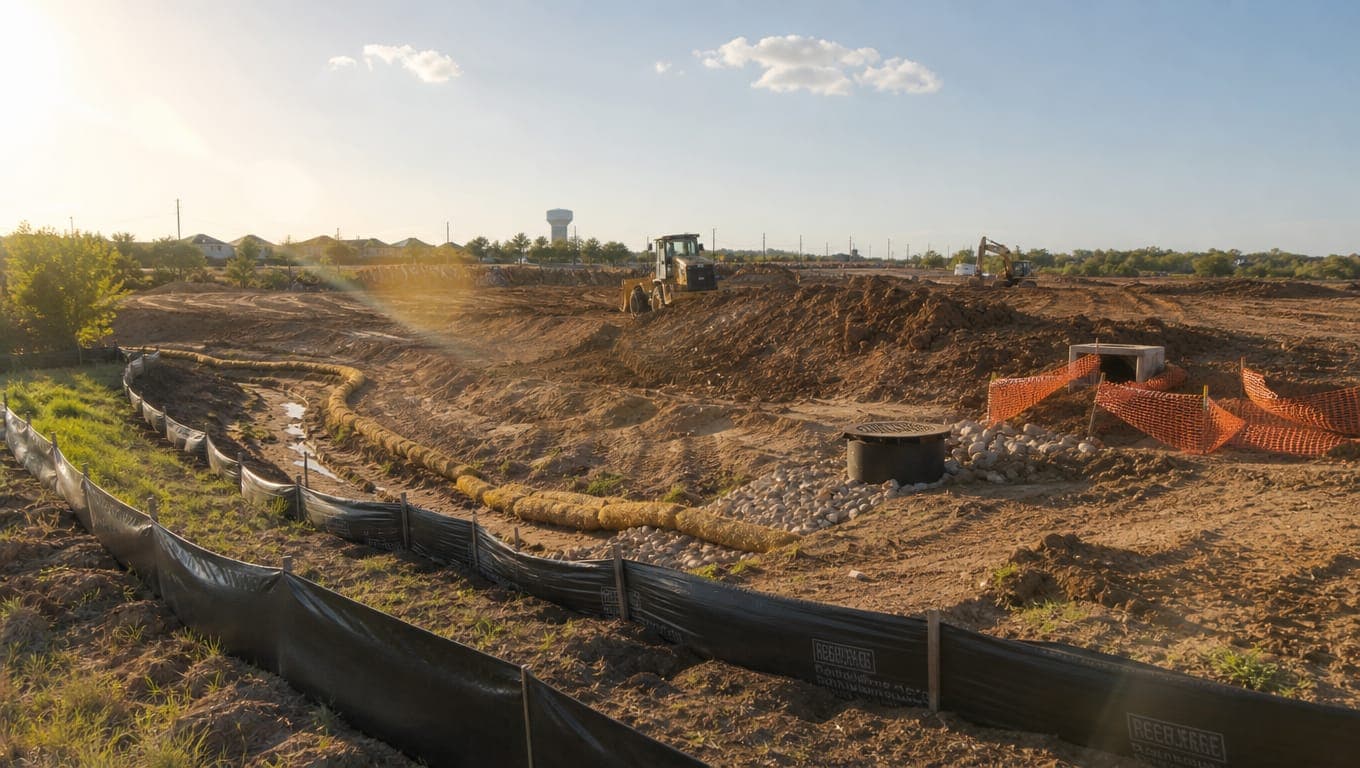 Compliance · 6 min
TXR150000 Explained for Texas Contractors
TXR150000 is the TCEQ Construction General Permit, the statewide authorization that lets Texas construction sites discharge stormwater legally. The current version took effect March 5, 2023 and expires March 5, 2028. It applies to sites disturbing one acre or more, and it is the document that
Get a stormwater
compliance quote.
Free site walk, written scope of work, fixed-price quote. Usually back to you within 48 hours.