
Bexar County Target Impervious Cover, Explained
Bexar County publishes target impervious cover percentages of 30% for single-family residential, 50% multi-family, 65% commercial and industrial, and 85% transportation. These are not development limits. They are thresholds that determine whether your project owes stormwater mitigation, and by how
Published October 12, 2026. Last reviewed October 12, 2026. Technical review: Jim Price, CISEC, CESSWI. Founder, Stormwater Compliant LLC.
Bexar County publishes target impervious cover percentages of 30% for single-family residential, 50% multi-family, 65% commercial and industrial, and 85% transportation. These are not development limits. They are thresholds that determine whether your project owes stormwater mitigation, and by how much.
Developers design to these numbers as if they were caps. They are not, and the difference is worth money on a constrained site.
These are not limits
Straight from the Bexar County Water Quality and Maintenance Manual:
These levels of impervious cover are not limits for the purpose of this calculation sheet and are only established as targets to establish a need for potential mitigation.
That is the county telling you, in its own document, that exceeding a target does not prohibit your development.
What exceeding a target does is create a mitigation obligation, expressed in points, which you satisfy by installing stormwater quality measures.
The practical consequence is significant. A developer who believes 65% is a hard ceiling on a commercial site designs the site to 65% and gives up yield. A developer who understands it is a mitigation trigger designs to what the project actually needs, calculates the mitigation, and prices it. On a constrained infill parcel, that can be the difference between a project working and not working.
To be clear about scope: this applies to the county's post-construction stormwater program in unincorporated Bexar County. Other constraints on impervious cover may apply to your site from other sources, including deed restrictions, platting conditions, and the City's own requirements inside the city limits. This article is about the county's mitigation calculation, not about every constraint on your site.
The four target percentages
| Land use category | Target impervious cover |
|---|---|
| Single-family residential | 30% |
| Multi-family residential | 50% |
| Commercial / industrial | 65% |
| Transportation | 85% |
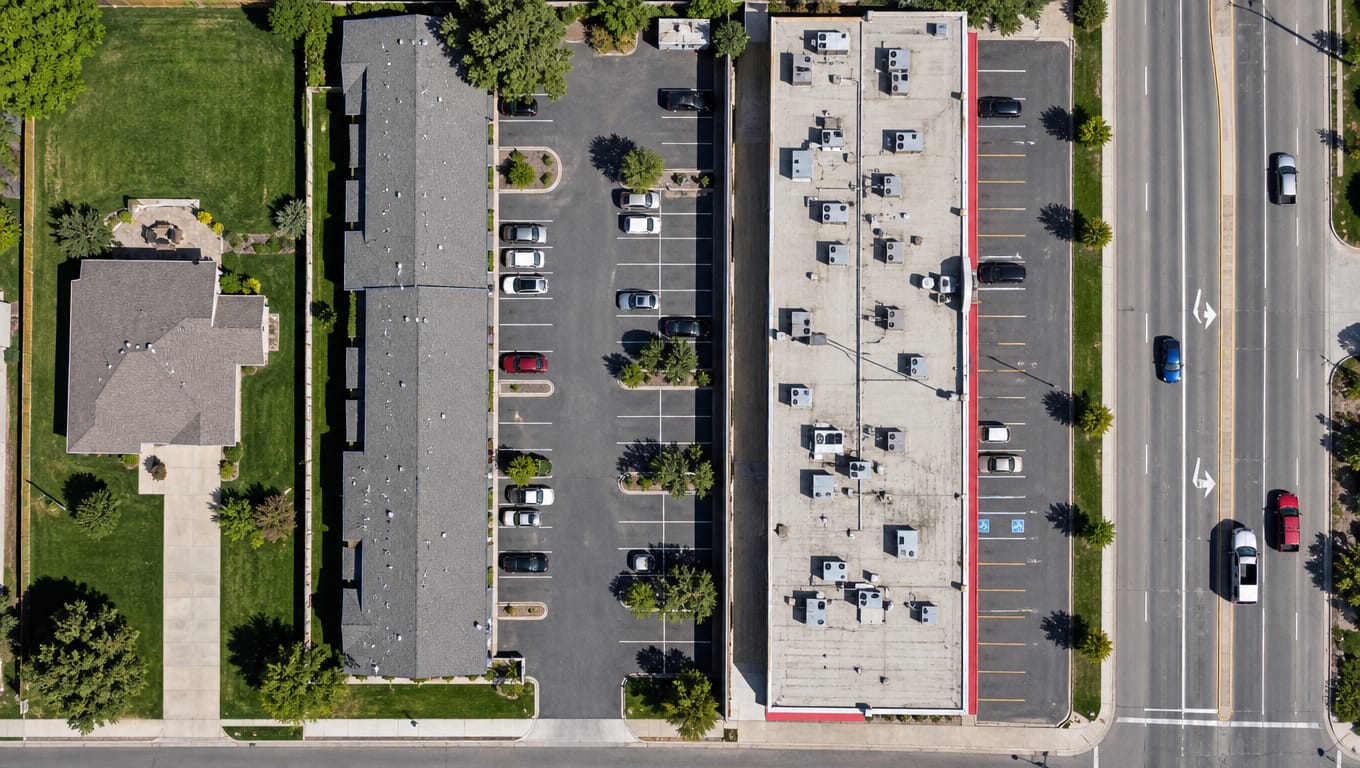
Impervious cover, for this purpose, means roads, parking areas, buildings, pools, patios, sheds, driveways, sidewalks, and other impermeable construction covering the natural land surface.
That definition is worth reading closely if you are calculating close to a threshold. Patios and sidewalks count. So do sheds.
Where the numbers come from
The county did not invent these percentages. Per the manual, the targets are set equal to the limitations for Category 2 properties under City of San Antonio Ordinance 81491, concerning development over the Edwards Recharge Zone. The manual describes them as representing a level of impervious cover acknowledged in the region for minimizing degradation to stormwater quality.
That provenance explains two things.
Why they feel strict. They originate from Recharge Zone protection standards, which are conservative by design.
Why they are targets rather than limits here. In their original context they functioned as limitations on a specific category of property. The county adopted the same numbers as a benchmark for a mitigation calculation, which is a different instrument doing a different job.
If someone tells you the county caps commercial development at 65% impervious cover, they have collapsed those two contexts.
How the calculation works
The county's calculation sheet works on composite figures, which matters for any project with more than one land use.
The sequence:
- Enter gross project acreage and the existing impervious cover on the property in square feet.
- Enter proposed acreage by land use category: single-family, multi-family, commercial and industrial, and transportation. The entire project acreage has to be accounted for, and it has to equal the existing project acreage entered earlier.
- Enter proposed impervious cover by square feet and by land use.
- The sheet calculates a composite target from your land use mix, and a composite proposed impervious cover percentage.
- Mitigation points equal the difference between composite proposed and composite target.
A worked illustration. Take a 10-acre project that is 7 acres commercial and 3 acres transportation. The composite target is not 65% and not 85%. It is the acreage-weighted blend of the two. Propose a composite impervious cover above that blended figure and the difference becomes your mitigation points. Propose below it and the points are negative, no mitigation is required, and you can skip the rest of the calculation worksheet.
That last outcome is worth aiming for on projects where it is achievable, because it removes the mitigation obligation entirely rather than reducing it.
The redevelopment rule that helps you
Here is a provision that favors redevelopment and almost nobody knows about.
If the existing impervious cover percentage on the property is already greater than the composite target, then mitigation points are measured as the difference between the proposed composite impervious cover and the existing impervious cover, rather than from the target.
Think about what that means on a redevelopment site.
Take an old commercial property that is already 80% impervious, well above the 65% commercial target. Redevelop it at 78% impervious cover and you are not measured against 65%. You are measured against the existing 80%, and since 78% is below it, the difference is negative. No mitigation required.
That is a genuine incentive to redevelop already-hardened sites rather than build on green land, and it is the kind of provision that changes a pro forma. If you are looking at a tired retail center or an old industrial parcel in the county, run this calculation before you assume mitigation cost.
Earning mitigation points
Where mitigation is required, points come from both structural and non-structural measures.
Structural BMPs are the permanent stormwater quality features: basins, filters, vaults, bioretention, and Low Impact Development practices. These carry the bulk of the points on most projects, and they are what you will be maintaining afterward under the Bexar County post-construction permit.
Non-structural measures also earn points, and they are cheap. Two confirmed examples from the manual:
- Public outreach. Distributing or posting the county's standardized public outreach flyer, included in closing or leasing documents where applicable, and posted in common areas such as mailbox kiosks and break rooms. 2 mitigation points. No proration for partial compliance.
- Inlet markers. Labeling storm drain inlets with plaques, tiles, or painted or precast messages warning against dumping, with common messages including "No Dumping" and "Drains to Waterways." 3 mitigation points for implementing on all storm sewer inlets. No proration, and points may also be available for markers on an adjacent inlet that receives stormwater from the project.
Note that reducing impervious cover earns no points directly. The manual is explicit that the applicant will not receive mitigation points for reducing impervious cover, but benefits by lowering the proposed percentage entered into the calculation, which reduces the points required in the first place. That is a better outcome than earning points, and worth pursuing through narrower travel lanes, shared parking, curb extensions, building clustering, multi-story construction, and permeable pavement.
The full point schedule is in the county's calculation sheet. We have published only the values we verified directly.
The fee-in-lieu cap
You can buy some of your mitigation, but not all of it.
Participation in the regional stormwater quality program through a fee in lieu is limited to 50% of the total project mitigation points. The remaining half has to be satisfied on site through actual measures.
So fee-in-lieu is a tool for closing a gap, not a substitute for a stormwater quality strategy. Any design that assumed the whole obligation could be paid off needs revisiting.
What this means for your yield
Four takeaways for anyone making layout decisions on a county site.
Do not design to the target as a ceiling. It is a threshold, not a cap. Design to what the project needs and price the mitigation.
Model the composite early. On a mixed-use project the blended target may be more forgiving than the individual figure you were anchored to.
Check the existing-cover rule on redevelopment. If the site is already above target, your baseline is the existing condition, and the mitigation obligation may be zero.
Reduce impervious cover where it is cheap to do so. It earns no points but it lowers the obligation, which is worth more.
Mitigation design is your engineer's call, and the calculation is theirs to run. What we do is build and maintain the resulting BMPs, and tell you early whether the mitigation approach in front of you is going to be maintainable for the next thirty years, which is a different question from whether it earns points.
We build and maintain the mitigation
Once the calculation is settled and your engineer has designed the mitigation, somebody has to build those BMPs, certify them, and maintain them for the life of the property. That is our work.
If you are early enough that the design is still moving, we are also worth a conversation about maintainability. A mitigation approach that earns the points and cannot be economically maintained is a problem you hand to the next owner, and increasingly to yourself.
Free site walk, written scope, fixed price, typically inside 48 hours.
Request a quote or call (210) 776-6515. See post-construction stormwater programs, BMP maintenance and repair, or the full local picture in San Antonio, Bexar County, and Edwards Aquifer stormwater rules.
Sources
Common questions
- What is the impervious cover limit in Bexar County?
- There is not one for this program. The county publishes target percentages, and its manual states plainly that they are not limits but targets establishing a need for potential mitigation.
- What are the target percentages?
- 30% single-family residential, 50% multi-family, 65% commercial and industrial, 85% transportation.
- Can I exceed 65% on a commercial site?
- For the county's mitigation calculation, yes. Exceeding the target creates a mitigation obligation rather than prohibiting the development. Other constraints from other sources may still apply to your site.
- How are mitigation points calculated?
- As the difference between your composite proposed impervious cover percentage and your composite target percentage, weighted across your land use mix.
- What if my site is already above the target?
- Then points are measured from the existing impervious cover rather than the target, which frequently means no mitigation is required on redevelopment.
- Can I just pay a fee instead of building BMPs?
- Only up to 50% of your total mitigation points. The rest has to be satisfied on site.
- Does reducing impervious cover earn points?
- No, but it reduces the points required, which is better.
The work behind this article
- Post-Construction Stormwater
An annual program that keeps your basins, vaults, and conveyance systems documented, inspected, and in regulatory good standing.
- Stormwater Basin and BMP Maintenance
A Texas stormwater maintenance company that runs your basins and ponds on a calendar instead of on emergencies. Mowing, vegetation, sediment, trash racks, and inlets on the scheduled visit, and crews on site within 72 hours when a control is failing between them.
- Stormwater Filter Service
Confined-space crews, OEM-spec cartridges in the truck, waste manifested off site. Your treatment vault back to design flow in a single visit.
Need help with stormwater compliance on a San Antonio property? We do site walks at no charge.
Request a fixed-price quoteMore field notes from the watershed.
 Compliance · 11 min
San Antonio, Bexar County, and Edwards Aquifer Stormwater Rules
A San Antonio construction site can sit under five separate stormwater authorities at once: TCEQ for the state permit, TCEQ's Edwards Aquifer Protection Program for the aquifer overlay, SAWS and the City of San Antonio inside city limits, and Bexar County Public Works in the unincorporated area
 Compliance · 7 min
Bexar County Post-Construction Permits: The Two-Part Process
Projects in unincorporated Bexar County disturbing one acre or more, or less than an acre as part of a larger common plan, need a post-construction storm water control measure permit. The process runs in two parts, a pre-construction review and a post-construction review, with engineer
Get a stormwater
compliance quote.
Free site walk, written scope of work, fixed-price quote. Usually back to you within 48 hours.