
Filing the Notice of Termination
A Notice of Termination must be filed within 30 days after final stabilization is achieved, operational control is transferred, or alternative authorization is obtained. Final stabilization generally means uniform perennial vegetative cover at 70% of native background density. Permit coverage
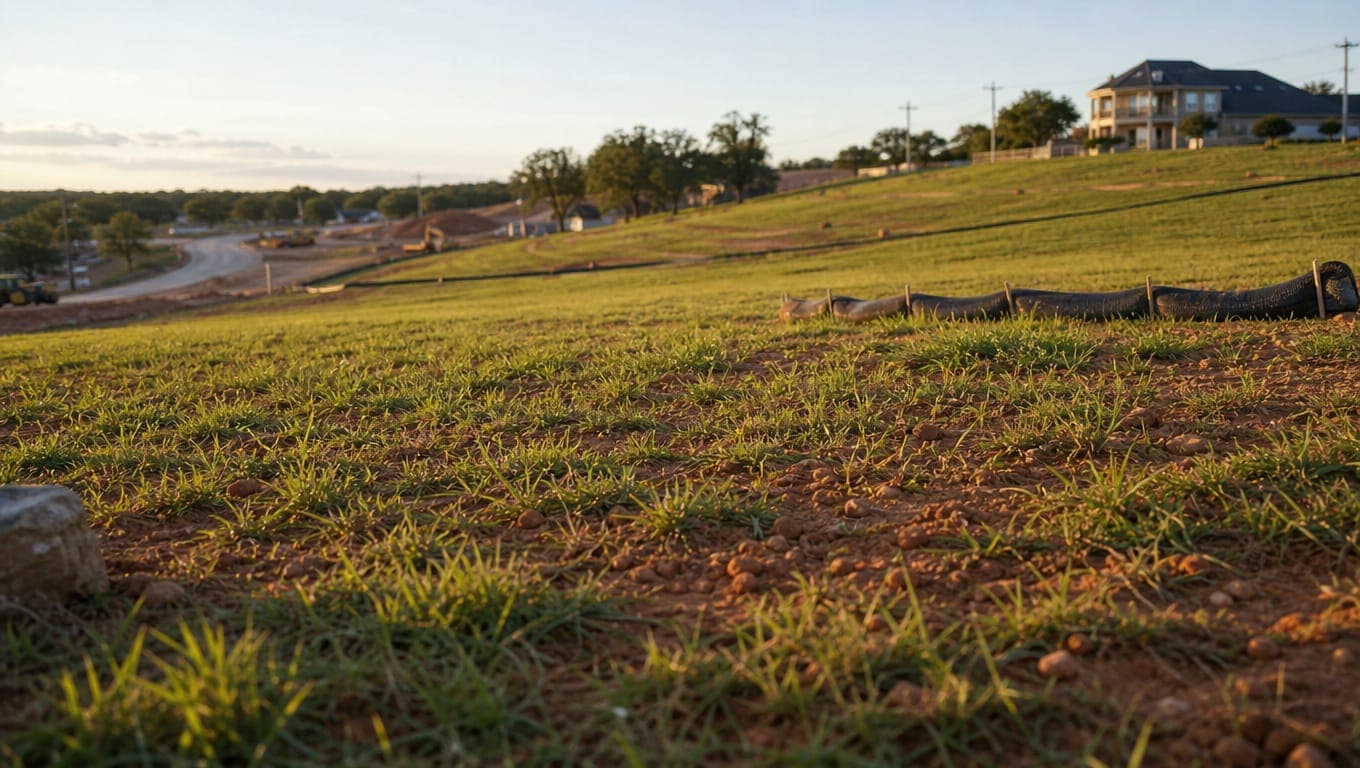
Published September 7, 2026. Last reviewed September 7, 2026. Technical review: Jim Price, CISEC, CESSWI. Founder, Stormwater Compliant LLC.
A Notice of Termination must be filed within 30 days after final stabilization is achieved, operational control is transferred, or alternative authorization is obtained. Final stabilization generally means uniform perennial vegetative cover at 70% of native background density. Permit coverage continues until TCEQ approves the NOT.
Demobilizing is not terminating. That distinction costs Texas contractors more money than any single violation in this permit.
Coverage does not end when you leave
Here is the sentence that matters, from Part II.F of the 2023 Construction General Permit:
Compliance with the conditions and requirements of this permit is required until the NOT is submitted and approved by TCEQ.
Not until the crew leaves. Not until the certificate of occupancy issues. Not until the owner takes possession. Until TCEQ approves the termination.
Everything that follows from that is uncomfortable. An open permit means the inspection schedule still applies, the SWP3 still has to be maintained, the site notice still has to be posted, and you are still the party a regulator contacts about a discharge from that property. On a site you have not visited in two years.
We find these regularly. Someone is doing due diligence on a commercial property, pulls the regulatory history, and discovers an authorization from 2019 that was never closed. It is not usually a crisis. It is always a mess, and it is entirely preventable by one filing.
The three conditions that start the 30-day clock
The NOT is due within 30 days after any of these:
- Final stabilization has been achieved on all portions of the site that are your responsibility.
- A transfer of operational control has occurred. If you hand the site to another operator, your clock starts then. See multi-operator sites and who holds the liability.
- You have obtained alternative authorization under an individual TPDES permit or a different general permit.
Most people only know about the first one, which means contractors who transfer a site mid-project routinely leave their own coverage open while a different operator runs the job.
Note the phrase "portions of the site that are the responsibility of the operator." On a multi-operator site your obligation attaches to your areas, not the whole plat.
Small construction sites, 1 to under 5 acres, do not file a NOT at all, because they never filed an NOI. They still have to reach final stabilization. See the 1-acre vs 5-acre rule.
What final stabilization actually requires
This is the substantive part, and it is where close-out schedules break.
From the Part I.B definition:
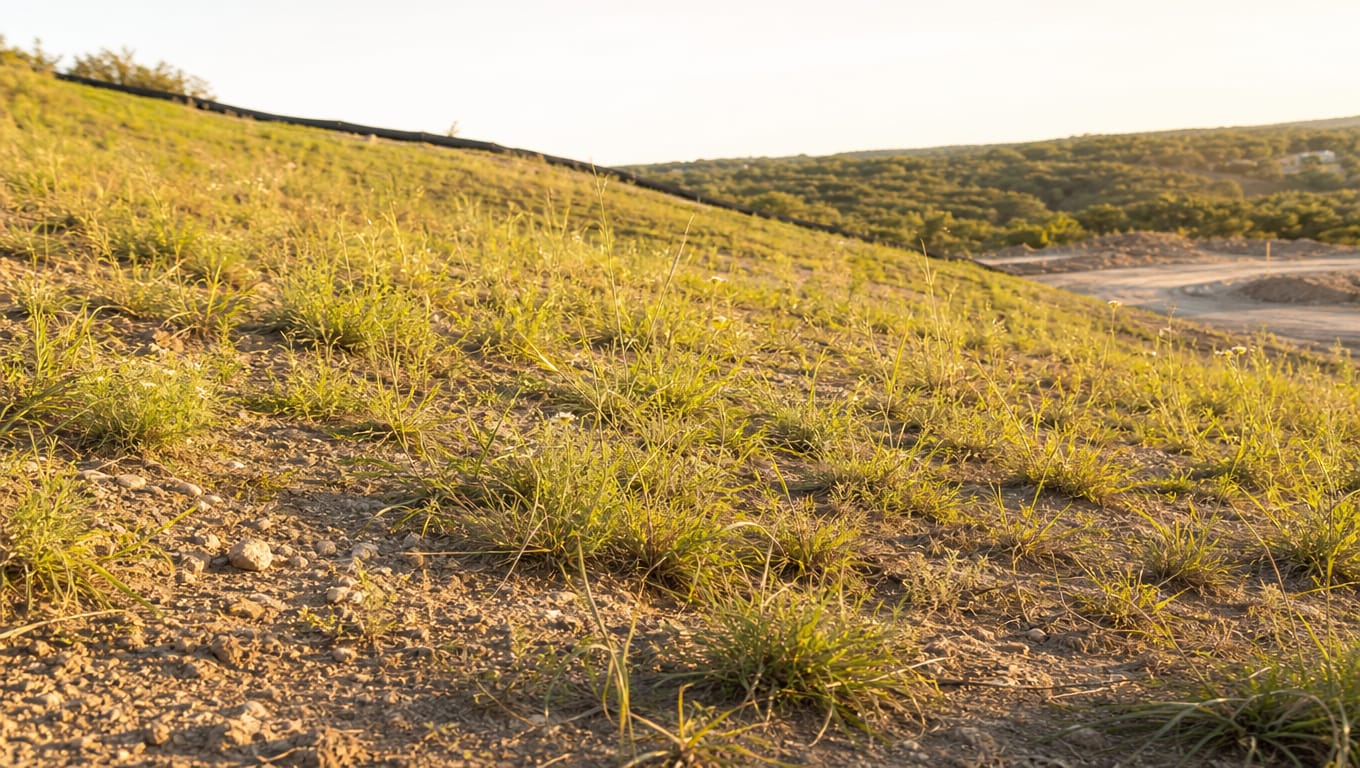
All soil disturbing activities at the site have been completed and a uniform (that is, evenly distributed, without large bare areas) perennial vegetative cover with a density of at least 70% of the native background vegetative cover for the area has been established on all unpaved areas and areas not covered by permanent structures, or equivalent permanent stabilization measures (such as the use of riprap, or gabions) have been employed.
Three parts worth pulling out.
"70% of the native background vegetative cover." Not 70% ground coverage in the abstract. Seventy percent of what grows naturally in that area, undisturbed. In parts of the Hill Country the native background is itself sparse, which means the target is lower than a landscaper would assume. Establishing the reference condition matters, and photographing an adjacent undisturbed area is a cheap way to document it.
"Uniform." The permit defines it: evenly distributed, without large bare areas. A site averaging 75% coverage with a bare quarter-acre on the back slope does not meet the standard. Averages do not satisfy this. Distribution does.
"Perennial." Annual cover that will not return next season is temporary stabilization, not final. This catches people who seed with a fast annual to get through inspection season.
The equivalent-measures alternative. Riprap, gabions, and similar permanent measures satisfy the standard without vegetation. On steep slopes and channel sections that is frequently the faster and more durable route.
The three alternate paths
Most readers do not know these exist. Each is written into the definition.
Residential lots
For individual lots in a residential construction site, the homebuilder can satisfy final stabilization by either:
- completing final stabilization as normal, or
- establishing temporary stabilization before transferring ownership of the home to the buyer, after informing the homeowner of the need for and benefits of final stabilization.
If temporary stabilization is not feasible, the builder may instead retain perimeter controls or BMPs and inform the homeowner of the need to remove those temporary controls and establish final stabilization.
Either way, fulfillment must be documented in the SWP3. That documentation requirement is the part builders miss. Telling the buyer verbally at closing satisfies nothing.
Agricultural land
For construction on land used for agricultural purposes, such as a pipeline crossing crop or range land, final stabilization can be accomplished by returning the disturbed land to its preconstruction agricultural use.
The exception is bounded. Areas that were not previously in agricultural use, including buffer strips immediately adjacent to surface water and any area not being returned to agricultural use, must meet the ordinary 70% standard.
Arid, semi-arid, and drought-stricken areas
This one matters in South and West Texas. In these areas only, final stabilization is met when all soil-disturbing activity is complete and both of the following are true:
- Temporary erosion control measures, for example a degradable rolled erosion control product, are selected, designed, and installed along with an appropriate seed base to provide erosion control for at least three years without active maintenance by the operator, and
- Those measures are selected, designed, and installed to achieve 70% of the native background vegetative coverage within three years.
Read that carefully before relying on it. It is not "we tried to seed and it is dry." It requires a designed installation intended to function unmaintained for three years. Done properly it is a legitimate close-out path on a drought-affected site. Done casually it is a finding.
Filing the NOT
Work through this in order.
Before you file
- All soil-disturbing activity complete on your portions of the site
- Final stabilization achieved, or an alternate path satisfied and documented
- Photographic documentation of the stabilized condition, dated
- Temporary controls removed where permanent stabilization has taken over
- Inspection records and corrective action documentation complete and filed
- SWP3 amendments current
Filing
- Submit the NOT electronically through STEERS, within 30 days of the triggering condition
- Reference the original NOI authorization
- Provide a copy of the NOT to the operator of any MS4 receiving the discharge, with those operators listed by name and address in the SWP3
After filing
- Confirm TCEQ approval. Submission alone does not end coverage.
- Retain the SWP3 and all records per the permit's retention requirements
- Take down the site notice
That MS4 copy is skipped constantly. It is a permit condition, and on a San Antonio project it generally means the City, with SAWS as co-permittee.
What if you never filed one?
If you suspect an old project still has open coverage, this is fixable and worth fixing.
Check first. TCEQ's public records will show authorizations tied to your customer number. An authorization with no termination on a project that finished years ago is an open permit.
Assess the site's current condition. In most cases a completed project has long since achieved final stabilization in fact, even though nobody documented it. That is the easy version.
Document what exists. Photograph the current stabilized condition against the standard. If cover meets 70% of native background and is uniform, you have what you need.
File the NOT. Late is better than never. The obligation does not expire.
If the site does not meet the standard, which happens on projects with bare back slopes, failed landscaping, or eroded areas, the stabilization work has to happen before the filing is honest. You are certifying a condition.
If you are carrying several old projects and do not know which are still open, that audit is worth doing once. Send us the project list. Request a quote or call (210) 776-6515.
The gap nobody budgets for
Here is the scheduling reality that produces most late filings.
Construction finishes. The site looks done. But vegetative cover takes a growing season to establish, and in San Antonio the establishment window is not year-round. Seed a slope in late July and you are not achieving 70% of native background until well into the next spring.
Meanwhile the crew is gone, the contract is closed, retainage is released, and the compliance obligation sits with whoever remembers it.
Three ways to close that gap:
Stabilize progressively. Areas that reach final grade early get their permanent cover early, not at the end. This also drops those areas to monthly inspection under Part III.F.8(c)ii, so it pays for itself twice. See stabilization deadlines contractors get wrong.
Use permanent non-vegetative measures where they fit. Riprap and gabions satisfy the standard on day one. On steep slopes and outfalls they are usually the better answer anyway.
Budget for the establishment period. Keep inspections and someone accountable through the growing season, then file. Treating close-out as a date rather than a condition is what leaves permits open.
Close it out properly
We handle close-out across San Antonio, Bexar County, Boerne, New Braunfels, and Seguin: assessing the site against the final stabilization standard, performing the stabilization work where there is a gap, documenting the condition, and filing the NOT.
If you have old projects you are not sure about, we will audit the list and tell you which are still open.
Free site walk, written scope, fixed price, typically inside 48 hours.
Request a quote or call (210) 776-6515. See BMP maintenance and repair, our SWPPP services, or the full permit walkthrough in our field guide to the TCEQ Construction General Permit.
Sources
Common questions
- When is the Notice of Termination due?
- Within 30 days after final stabilization on your portions of the site, a transfer of operational control, or obtaining alternative authorization.
- When does my liability actually end?
- When the NOT is submitted and approved by TCEQ. Not at submission, and certainly not at demobilization.
- What does 70% vegetative cover mean?
- Seventy percent of the native background vegetative cover for the area, uniformly distributed without large bare areas, with perennial cover.
- Can I use riprap instead of vegetation?
- Yes. Equivalent permanent stabilization measures such as riprap or gabions satisfy the standard.
- Do small construction sites file a NOT?
- No. Sites of 1 to under 5 acres never filed an NOI, so there is nothing to terminate. They still must reach final stabilization.
- What if a homebuilder sells before stabilization?
- The permit allows temporary stabilization before transfer, provided the homeowner is informed of the need for final stabilization and it is documented in the SWP3.
- We never filed on a project from years ago. What now?
- Verify the site meets final stabilization, document it, and file. The obligation does not expire, and late filing is better than an indefinitely open permit.
The work behind this article
- Stormwater Pollution Prevention Plan (SWPPP)
A San Antonio SWPPP company that writes the plan, files the NOI, and walks the binder with your superintendent. Site-specific to your grading plan, written to TXR150000, not a template with somebody else's logo taken off.
- Stormwater Basin and BMP Maintenance
A Texas stormwater maintenance company that runs your basins and ponds on a calendar instead of on emergencies. Mowing, vegetation, sediment, trash racks, and inlets on the scheduled visit, and crews on site within 72 hours when a control is failing between them.
- Stormwater Inspection Services
CISEC and CESSWI inspectors, on your site every seven days while the job is live and on your MS4's schedule once it is not. One inspector, one tablet, forty checkpoints, and the report before the truck leaves the property.
Need help with stormwater compliance on a San Antonio property? We do site walks at no charge.
Request a fixed-price quoteMore field notes from the watershed.
 Compliance · 14 min
Texas SWPPP Requirements: A Field Guide to the TCEQ Construction General Permit
If your project will disturb one acre or more of soil in Texas, you need coverage under the TCEQ Construction General Permit, TXR150000, and a Stormwater Pollution Prevention Plan in place before construction begins. Sites of five acres or more must also file a Notice of Intent. Smaller sites
 Compliance · 7 min
Stabilization Deadlines Contractors Get Wrong
Under TXR150000, stabilization must be initiated immediately, meaning no later than the end of the next work day, wherever earth-disturbing activity has permanently ceased or has temporarily ceased and will not resume within 14 calendar days. Once initiated, it must be completed within 14 calendar
Get a stormwater
compliance quote.
Free site walk, written scope of work, fixed-price quote. Usually back to you within 48 hours.