
UDC 35-504 and San Antonio Site Design
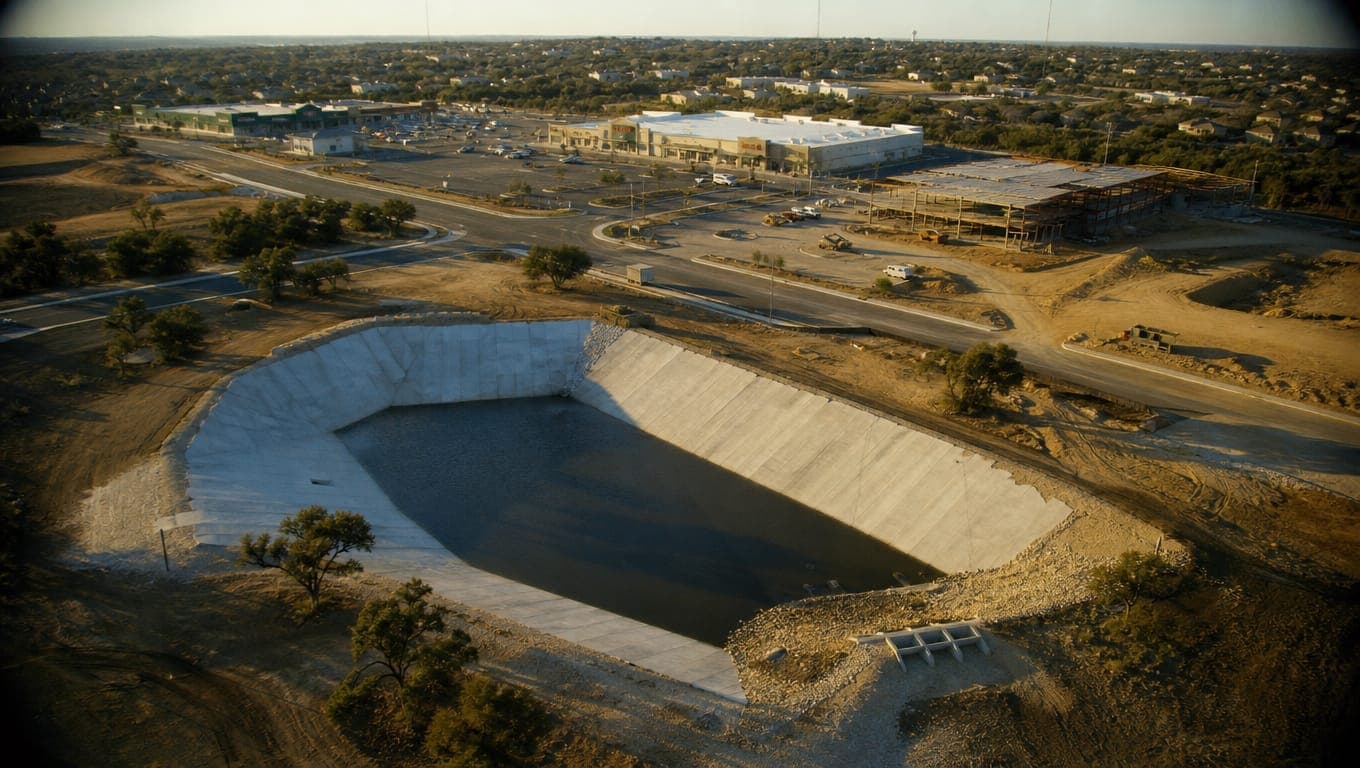
Section 35-504 of San Antonio's Unified Development Code governs stormwater management on development inside the city: detention requirements, outflow limits, the regional program alternative, and drainage design. Projects increasing impervious area by more than 0.1 acres must provide detention
Published October 15, 2026. Last reviewed October 15, 2026. Technical review: Jim Price, CISEC, CESSWI. Founder, Stormwater Compliant LLC.
Section 35-504 of San Antonio's Unified Development Code governs stormwater management on development inside the city: detention requirements, outflow limits, the regional program alternative, and drainage design. Projects increasing impervious area by more than 0.1 acres must provide detention unless they participate in the Regional Stormwater Management Program.
One caution before you use anything here: read the section on water quality criteria before you rely on any number you have been given for San Antonio.
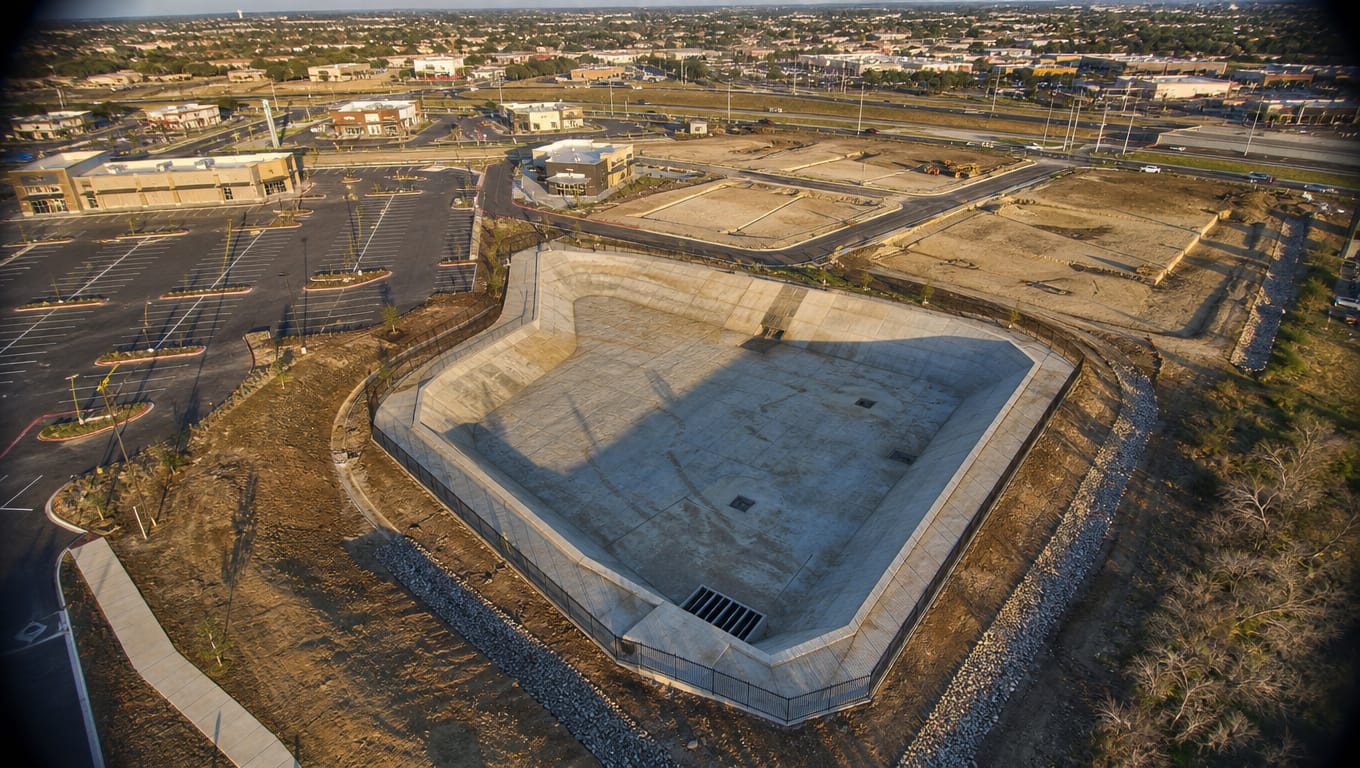
What section 35-504 covers
The section's stated purpose is to provide adequate measures for the retention and detention of stormwater and to address both water quantity and water quality during development, including through innovative runoff management practices.
In practice it is the instrument that decides, for a site inside the city limits:
- Whether you build on-site detention or buy into a regional facility
- How much your basin may release, and at what storm frequencies
- How your discharge must behave relative to the receiving watercourse
- Who owns and maintains the facility afterward
It sits alongside, not instead of, the state and aquifer layers. Chapter 34 of the City Code separately references the TCEQ construction general permit for construction-phase compliance, and if your site is over the Edwards Aquifer, TCEQ's approval of your protection plan is a precondition to breaking ground regardless of what the UDC says. See San Antonio, Bexar County, and Edwards Aquifer stormwater rules.
The regional program alternative
Many designers do not know this option exists, and it can change a site plan fundamentally.
Rather than constructing on-site detention, an eligible project may participate in the Regional Stormwater Management Program, paying a stormwater development fee in lieu of on-site detention. The city maintains regional detention and retention facilities, watershed-scale infrastructure, and arrangements including San Antonio River Authority flood control facilities that serve this purpose.
Two things to understand about it.
Eligibility is not universal. Whether a project can participate depends on the watershed and the applicable regional plan. Some areas are served by the regional program and some require on-site detention regardless.
The fee must be paid. The stormwater development fee in lieu of on-site detention is a condition, not an intention.
Where it is available, the trade is straightforward: capital and land area now, against a fee, and against not owning a basin for the next several decades. On a tight urban parcel where detention would consume developable area, that arithmetic frequently favors the regional program.
Ask about it early. Discovering the option after the site plan is fixed around a basin wastes the opportunity.
When on-site detention is required
For projects with an increased impervious area of greater than 0.1 acres that do not participate, or are not eligible to participate, in the Regional Stormwater Management Program, stormwater detention is required for all new development or redevelopment of individual parcels, to mitigate peak flow rates to predevelopment or existing-development conditions.
Note how low that trigger is. 0.1 acres of increased impervious area is roughly 4,356 square feet. A modest building addition with its associated paving can cross it. This is not a threshold that only large developments encounter.
How detention has to perform
The performance requirement is a multi-frequency one, which is stricter than a single design storm.
The maximum allowable outflow rate from the detention facility must be restricted to the flow rate from the undeveloped or existing development tract for the 5-year, 25-year, and 100-year frequencies.
Three separate frequencies, all of which must be satisfied. A basin sized to control the 100-year event does not automatically satisfy the 5-year requirement, and in practice the smaller frequencies often govern the outlet design. Multi-stage outlet structures are the normal response, and they are also, in our experience, the component most likely to be built slightly wrong and most likely to clog.
The section also directs that best management practices be used in the design of detention facilities.
Protecting the receiving watercourse
Two provisions look past your property line, and both are easy to overlook.
Hydrograph timing. The timing of the hydrograph released from the detention facility must be checked against the timing of the flow rate in the first open watercourse, to prevent any increase in the peak flow rate in the receiving watercourse.
This is a real and under-appreciated requirement. A basin can satisfy every peak-release limit and still make things worse downstream if its release coincides with the receiving stream's own peak. Meeting the outflow numbers is not the same as demonstrating no increase downstream.
In-line basins. For detention basins constructed in-line on an existing watercourse, the creation of the basin must not increase flood elevations in the channel upstream of the new development boundaries.
In-line detention is attractive when it is available and it carries this additional constraint. Backwater effects upstream are the failure mode.
The section also contains provisions addressing low water crossings and increases in flow at those crossings for the design frequencies, which matters in a metro with as many low water crossings as this one.
Who owns and maintains it, forever
This is the provision with the longest tail, and the one property owners are least prepared for.
On-site detention facilities constructed as a requirement of UDC 35-504 must be privately owned and maintained by the property owner or the community association, with a maintenance schedule submitted to the Infrastructure Services Department.
Related, and pointing the same direction: stormwater retention with a permanent wet pool, or pumped detention, is generally not accepted as a method of stormwater mitigation unless the facility will remain privately owned, operated, and maintained.
Read together, the city is saying at design stage that this basin belongs to somebody, permanently, and that the city is not going to inherit it.
What that means in practice:
For developers. The maintenance obligation transfers with the property. It should be disclosed, and the maintenance schedule on file with Infrastructure Services should be handed over rather than forgotten.
For HOA boards. The community association is frequently the named maintaining party, and the obligation is perpetual. It belongs in the reserve study, not in the annual landscaping line.
For commercial owners. You bought the basin along with the building. The maintenance schedule on file is a commitment made in your name, or your predecessor's, and it does not lapse because nobody mentioned it at closing.
For buyers. Ask, during due diligence, whether there is a detention facility, what the filed maintenance schedule says, and when it was last actually done. The answer to the third question is frequently "never."
This is the single most common way we meet San Antonio property owners: they inherited a basin they did not know was theirs, and something has started going wrong with it.
A necessary note on water quality criteria
Here is where we tell you what we could not verify, because it matters more than what we could.
We are not publishing specific water-quality volume or drawdown figures for San Antonio, and you should be careful about any source that does.
The reason: the UDC 35-504 document that circulates and is readily downloadable is dated January 1, 2006, and carries an explicit notice on every page stating that it is an unedited work document, not for public distribution, intended for in-house staff use only, and directing readers to the codified version on MuniCode or on file with the City Clerk for legal interpretation.
That is not a source anyone should be quoting numeric design criteria from, and yet figures traceable to that vintage and to neighboring jurisdictions circulate in this market as current San Antonio requirements.
The specific contamination risk is Austin. Austin and San Antonio both regulate development over the Edwards Aquifer. Their documents look similar, their concerns overlap, and water quality volume and drawdown figures migrate between them in consultant summaries and vendor content. Austin's criteria are not San Antonio's, and a design built to the wrong city's numbers is either over-built or non-compliant.
It is worth contrasting this with a case where the migration is legitimate. TCEQ's own Edwards Aquifer guidance, RG-348, credits its clay liner specification table to City of Austin 2004 criteria. There, TCEQ deliberately adopted the Austin specification into its own published manual, so it applies. See basin lining requirements over the Recharge Zone.
The test is simple: did the governing authority adopt and publish it? If TCEQ put it in RG-348, it applies. If a consultant put an Austin number into a San Antonio summary, it does not.
The city has also amended the UDC's stormwater provisions over time, including work addressing water quality and channel erosion through on-site Low Impact Development, on the reasoning that the large majority of San Antonio rainfall occurs in events smaller than the 5-year storm and those smaller storms drive water quality and channel erosion impacts. That direction is worth knowing. The current numeric criteria attached to it are worth confirming.
Where to get the authoritative text
For anything load-bearing:
The codified UDC on MuniCode. This is the version the 2006 document itself points you to, and the one that governs.
The City Clerk's office, which holds the official copy.
Development Services, for interpretation on a specific project.
And if you would rather not do that yourself, send us the address and the question. We will pull the current section and tell you what it says today rather than what a PDF said in 2006. That costs you nothing.
We maintain the basin you now own
If you own commercial property or sit on an HOA board in San Antonio, there is a reasonable chance a detention facility on your property carries a maintenance schedule filed with the city in your name, and a reasonable chance nobody has looked at it in years.
We inspect, maintain, and repair these across the metro, on flat annual billing, with the documentation that demonstrates the commitment is being met.
And if you are still in design and want the current UDC section confirmed rather than assumed, send us the address. Free, and quicker than you would expect.
Request a quote or call (210) 776-6515. See post-construction stormwater programs, detention and retention basin repair, or the full local picture in San Antonio, Bexar County, and Edwards Aquifer stormwater rules.
Sources
- City of San Antonio, codified Unified Development Code, available on MuniCode. The authoritative source.
- City of San Antonio UDC 35-504, Stormwater Management (PDF as hosted by Bexar County). Dated January 1, 2006 and marked as an unedited in-house work document. Cited here for structural provisions only, not for numeric design criteria.
- City of San Antonio, 2022 Stormwater Management Plan, TPDES Permit WQ0004284000 (PDF)
- TCEQ, Complying with the Edwards Aquifer Rules (RG-348)
Common questions
- What does UDC 35-504 require?
- Stormwater management on development inside San Antonio: detention or regional program participation, outflow restricted to predevelopment rates for the 5-year, 25-year, and 100-year frequencies, protection of the receiving watercourse, and private ownership and maintenance of on-site facilities.
- When is on-site detention required?
- For projects increasing impervious area by more than 0.1 acres that do not participate, or cannot participate, in the Regional Stormwater Management Program.
- Can I pay a fee instead of building detention?
- Where the project is eligible, yes, through the Regional Stormwater Management Program with a stormwater development fee in lieu of on-site detention. Eligibility depends on the watershed and applicable regional plan.
- Who maintains the detention basin?
- The property owner or community association, privately, with a maintenance schedule filed with the Infrastructure Services Department. The city does not take it over.
- What is the water quality volume requirement in San Antonio?
- Confirm it against the codified UDC on MuniCode. We are not publishing a figure because the readily available document is a 2006 in-house draft, and figures circulating in this market are sometimes Austin's rather than San Antonio's.
- Does the UDC cover my Edwards Aquifer requirement?
- No. That is a separate TCEQ review under 30 TAC Chapter 213, and construction cannot commence until it is approved.
The work behind this article
- Post-Construction Stormwater
An annual program that keeps your basins, vaults, and conveyance systems documented, inspected, and in regulatory good standing.
- Detention Pond and Basin Repair
Bathymetric survey, sediment removal, regrading, and outlet rebuild for detention ponds and retention basins that have silted in, washed out, or stopped draining the way the design drawing said they would.
- Stormwater Pollution Prevention Plan (SWPPP)
A San Antonio SWPPP company that writes the plan, files the NOI, and walks the binder with your superintendent. Site-specific to your grading plan, written to TXR150000, not a template with somebody else's logo taken off.
Need help with stormwater compliance on a San Antonio property? We do site walks at no charge.
Request a fixed-price quoteMore field notes from the watershed.
 Compliance · 11 min
San Antonio, Bexar County, and Edwards Aquifer Stormwater Rules
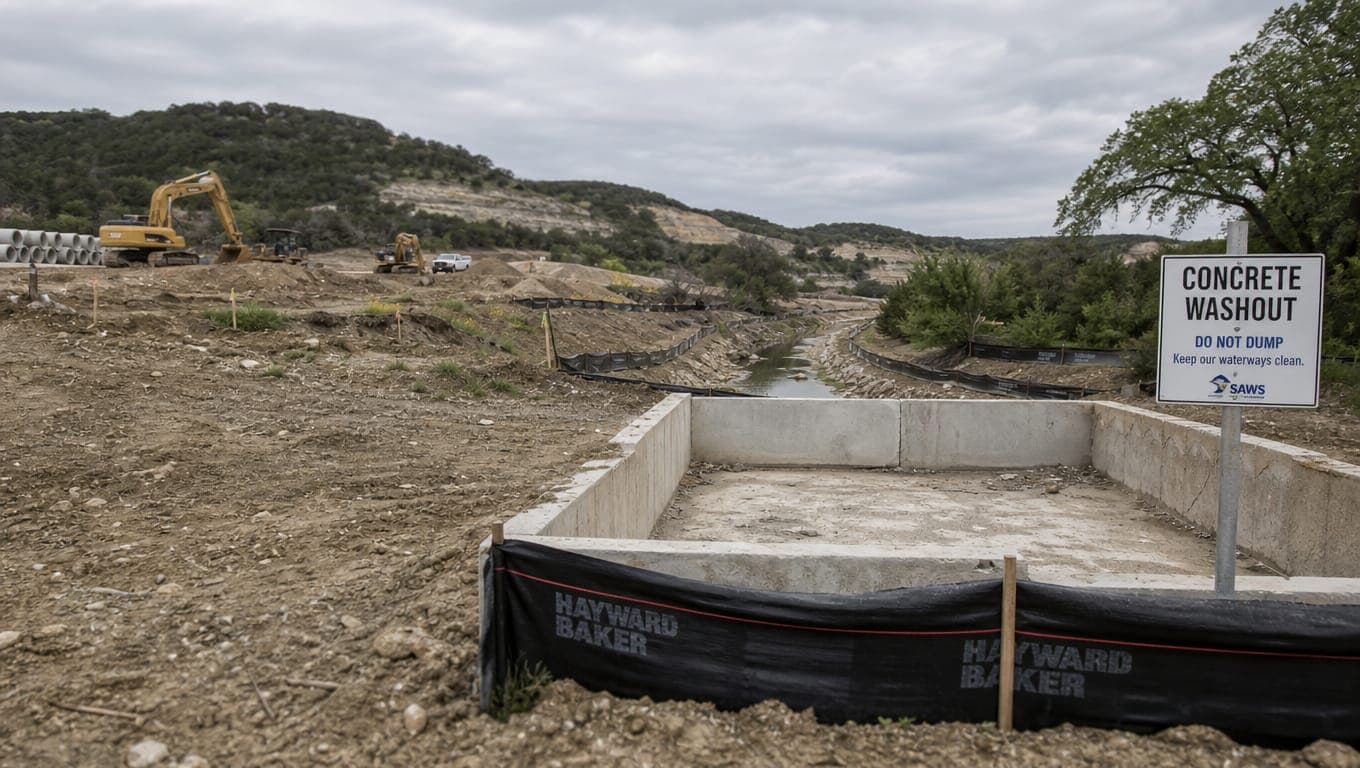
A San Antonio construction site can sit under five separate stormwater authorities at once: TCEQ for the state permit, TCEQ's Edwards Aquifer Protection Program for the aquifer overlay, SAWS and the City of San Antonio inside city limits, and Bexar County Public Works in the unincorporated area
 Compliance · 7 min
The SAWS Construction Stormwater Ordinance (2014-06-19-0472)
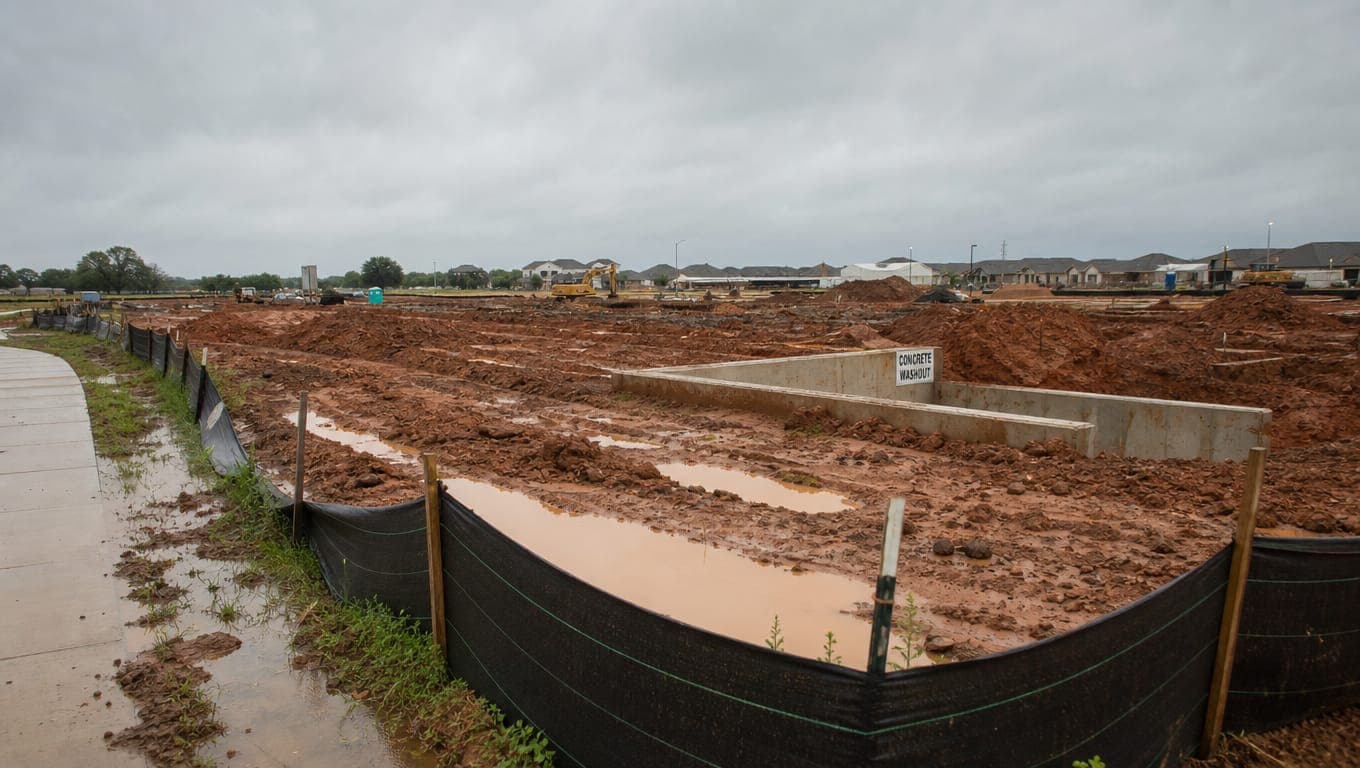
San Antonio Water System enforces construction stormwater requirements locally as an MS4 co-permittee with the City of San Antonio and TxDOT, under ordinance 2014-06-19-0472, approved by City Council on June 19, 2014. The ordinance requires a certified SWPPP, the TPDES permit posted on site, and
Get a stormwater
compliance quote.
Free site walk, written scope of work, fixed-price quote. Usually back to you within 48 hours.