
How Often Are SWPPP Inspections Required in Texas?
Texas construction sites must be inspected at least once every 14 calendar days and within 24 hours of the end of a storm event of 0.5 inches or greater. The permit also allows an elective schedule of once every 7 calendar days regardless of rainfall, plus reduced monthly frequencies for
Published August 24, 2026. Last reviewed August 24, 2026. Technical review: Jim Price, CISEC, CESSWI. Founder, Stormwater Compliant LLC.
Texas construction sites must be inspected at least once every 14 calendar days and within 24 hours of the end of a storm event of 0.5 inches or greater. The permit also allows an elective schedule of once every 7 calendar days regardless of rainfall, plus reduced monthly frequencies for stabilized, frozen, and drought-affected areas.
Most guides publish the first sentence and stop. The permit contains five schedules, and picking the right one changes how much work your team actually does.
The default schedule
From Part III.F.8(c)i of the 2023 Construction General Permit:
Inspections of construction sites must be conducted at least once every fourteen (14) calendar days and within 24 hours of the end of a storm event of 0.5 inches or greater.
Two separate triggers, both live at once. The 14-day clock runs regardless of weather. The storm trigger fires independently. A site that gets three qualifying storms in a fortnight owes four inspections that period, not one.
Fourteen calendar days, not business days. Holidays do not extend it.
What counts as a storm event
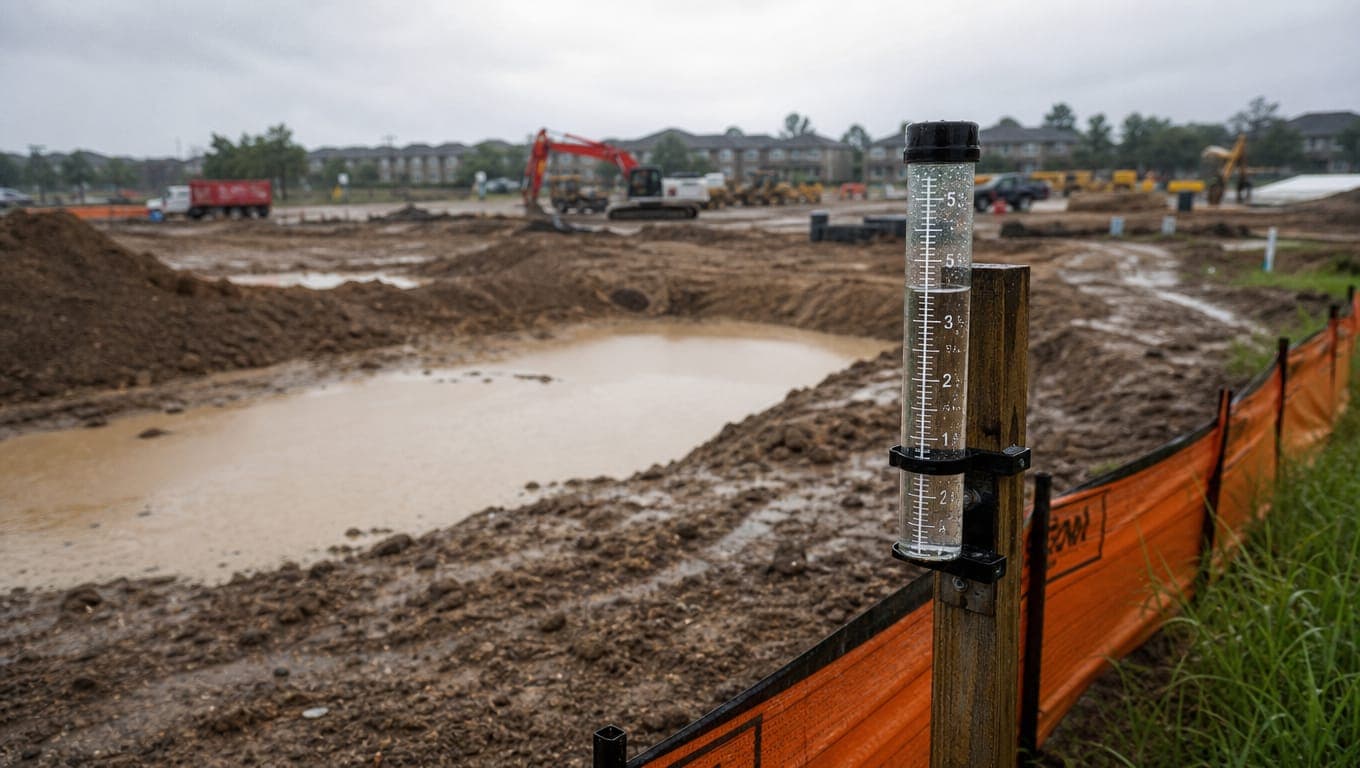
Half an inch or more within a 24-hour period, measured at the site. Keep a rain gauge on site and record readings, because "the airport said 0.4 inches" is a weak position when the inspector's data says otherwise.
Cumulative rainfall counts. Multiple smaller storms that alone produce less than 0.5 inches, but together produce 0.5 inches or more within 24 hours, trigger the requirement just as a single storm would. You owe one inspection within 24 hours of when the half-inch mark was reached.
Multi-day storms
This provision saves real money and almost nobody publishes it.
If a storm produces 0.5 inches or more on the first day and continues producing qualifying rainfall on subsequent days, you owe two inspections total, not one per day: one within 24 hours of the first day, and one within 24 hours after the last day that produces 0.5 inches or more.
The permit says so explicitly. Crews that inspect daily through a week-long wet spell are doing several inspections they do not owe, and the labor adds up across a large site.
When the window falls outside working hours
If the 24-hour window falls entirely outside normal working hours, you must inspect by no later than the end of the next business day.
That covers the Friday night storm. You are not obligated to send someone out on Saturday morning if your normal working hours do not include it. You are obligated Monday.
The 7-day alternative most contractors don't know about
Part III.F.8(c)v offers a genuine alternative to the whole weather-triggered scheme:
As an alternative to the inspection schedule in Part III.F.8.(c)i. above, the SWP3 may be developed to require that these inspections will occur at least once every seven (7) calendar days. If this alternative schedule is developed, then the inspection must occur regardless of whether or not there has been a rainfall event since the previous inspection.
Weekly, every week, rain or no rain. No rainfall tracking, no 24-hour scrambles, no argument about whether Tuesday's storm hit half an inch.
The honest tradeoff: you will perform more inspections in a dry season and fewer in a wet one. In San Antonio, where May can deliver several qualifying storms in a fortnight and August can deliver none, the arithmetic is closer than people expect.
Why crews choose it anyway: predictability. A fixed weekly item survives staff turnover, gets scheduled like any other recurring task, and does not depend on somebody checking a rain gauge on a Saturday. Most of the compliance failures we document are not failures of will, they are failures of a weather-triggered obligation landing on a week when the person who tracks it was out.
If you want this schedule, it has to be written into the SWP3. Choosing it informally and inspecting weekly while your plan says 14-day-plus-storm means your records do not match your plan, which is its own violation.
Four situations that change your frequency
| Situation | Required frequency | Permit section |
|---|---|---|
| Default | Every 14 calendar days, plus within 24 hours of the end of a 0.5-inch storm | III.F.8(c)i |
| Elective alternative | Every 7 calendar days regardless of rainfall | III.F.8(c)v |
| Areas at final or temporary stabilization | At least once per month | III.F.8(c)ii |
| Frozen conditions where runoff is unlikely | At least once per month until thawing begins | III.F.8(c)iii |
| Arid, semi-arid, or drought-stricken areas | At least once per month, plus within 24 hours after a 0.5-inch storm | III.F.8(c)iv |
Two of these matter more in this market than people realize.
Stabilized areas drop to monthly. On a phased project where early areas reached stabilization months ago, you are not obligated to inspect those areas on the full schedule. Documenting stabilization properly reduces your ongoing inspection burden. That is a real, legal reason to stabilize promptly rather than deferring it. For the timing on when those areas have to be stabilized, see stabilization deadlines contractors get wrong.
Drought conditions drop to monthly plus post-storm. San Antonio spends meaningful stretches in drought designation. If you use this provision, the SWP3 must record the total rainfall measured and the approximate beginning and ending dates of the drought conditions that justified the reduced frequency. Without that record, monthly inspections during a dry spell look like missed inspections.
The frozen-conditions provision has the same documentation requirement: record the approximate start and end dates of the frozen period.
Linear sites and representative inspections
Pipeline, utility, and roadway work gets its own treatment under Part III.F.8(d), because driving the full alignment after every storm can cause more disturbance than it prevents.
Linear sites still follow the 14-day-plus-storm schedule, or the 7-day elective, but representative inspections are permitted. Personnel inspect controls for 0.25 mile above and below each access point where a roadway, undisturbed right-of-way, or similar feature intersects the site. Conditions along each inspected quarter-mile are treated as representative of the reach extending to the next inspected segment or the end of the project.
The SWP3 has to reflect the current schedule, and schedule changes follow the same constraints as everywhere else.
Switching schedules without creating a violation
You can change schedules. There are rules.
Per Part III.F.8(c)vi, the inspection frequency schedule:
- can be changed a maximum of once per calendar month
- must be implemented within the first five business days of a calendar month
- requires the reason documented in the SWP3, for example the end of dry season and the beginning of wet season
That is a sensible provision and it catches people who treat schedule selection as informal. Deciding mid-month to switch from weekly to 14-day-plus-storm because the crew is stretched, without documenting it, produces an inspection record that does not match the plan.
Pick a schedule deliberately at the start of a month, write it down, and leave it alone.
Who is allowed to inspect
The permit does not require a third-party inspector. Your own qualified personnel can perform these inspections. Anyone telling you otherwise is selling something.
Here is the honest version of the risk.
The inspection record is what gets audited. Not the site, the record. When TCEQ or a local inspector reviews a project, they read the inspection reports, the corrective action documentation, and the SWP3 amendments. Sites where the physical controls were fine still fail, routinely, because the paper does not hold up.
Self-inspection records fall apart in predictable ways: gaps during vacation and turnover, missing post-storm entries because nobody was tracking rainfall, findings recorded with no corresponding corrective action, and photos with no timestamp or location. None of those are failures of competence. They are failures of a secondary duty competing with a primary job.
Certifications like CISEC and CESSWI are not required by the permit. They matter because a credentialed inspector's report carries more weight in a dispute, and because the person carrying the credential does this full time rather than between other responsibilities.
If your superintendent has the bandwidth and the discipline, self-inspection is legal and workable. If they do not, the honest question is not whether it is allowed but whether your records will survive review. Our 40-point inspection service exists for the sites where the answer is no.
What the inspection has to produce
Walking the site is not the deliverable. The record is.
Each inspection should generate:
- Date, time, and the inspector's name
- Weather conditions and rainfall since the last inspection
- The condition of every control, with location
- Photographs, timestamped and located
- Findings, with severity
- Corrective actions, with the date each was completed
- Any resulting SWP3 amendments
- Signature
That corrective action line is the most-failed requirement we encounter. Sites find the problem, physically fix it, and never document the fix. On the next inspection the same item is cited again, and now there is a pattern of repeat findings in the record with no evidence of response. More on that in the most common SWPPP violations on San Antonio job sites.
Note also that BMP modifications carry their own clock: if existing controls are modified or new ones added, the SWP3 must be updated within seven calendar days.
Want the inspection off your plate?
We run scheduled inspection programs across San Antonio, Bexar County, Boerne, New Braunfels, and Seguin. Photo-documented, GPS and timestamp on every shot, report delivered the same day, and findings triaged by severity so you know what needs attention this week versus this quarter.
Our inspectors hold CISEC and CESSWI credentials and do this full time. Free site walk, written scope, fixed price, typically inside 48 hours.
Request a quote or call (210) 776-6515. See our 40-point stormwater inspection, or the full permit walkthrough in our field guide to the TCEQ Construction General Permit.
Sources
Common questions
- How often do I have to inspect a Texas construction site?
- Every 14 calendar days and within 24 hours of the end of a storm event of 0.5 inches or greater, unless your SWP3 documents the elective 7-day schedule or one of the reduced-frequency situations applies.
- Does it rain 0.5 inches at my site or at the airport?
- At your site. Keep a rain gauge and record readings.
- If it rains for four days straight, do I inspect four times?
- No. A multi-day qualifying storm requires two inspections: one within 24 hours of the first day, one within 24 hours after the last day producing 0.5 inches or more.
- Can I inspect weekly instead of tracking rain?
- Yes, under Part III.F.8(c)v, if it is documented in the SWP3. The weekly inspection happens regardless of rainfall.
- Do I inspect areas that are already stabilized?
- Yes, at least once per month, provided the stabilization is documented.
- Does drought reduce my inspection frequency?
- In arid, semi-arid, or drought-stricken areas, yes, to monthly plus within 24 hours after a 0.5-inch storm. The SWP3 must record rainfall totals and the beginning and ending dates of the drought conditions.
- Do I need a certified inspector?
- Not under the permit. Whether your self-inspection records will survive an audit is a separate question worth answering honestly.
The work behind this article
- Stormwater Inspection Services
CISEC and CESSWI inspectors, on your site every seven days while the job is live and on your MS4's schedule once it is not. One inspector, one tablet, forty checkpoints, and the report before the truck leaves the property.
- Stormwater Pollution Prevention Plan (SWPPP)
A San Antonio SWPPP company that writes the plan, files the NOI, and walks the binder with your superintendent. Site-specific to your grading plan, written to TXR150000, not a template with somebody else's logo taken off.
- Stormwater Basin and BMP Maintenance
A Texas stormwater maintenance company that runs your basins and ponds on a calendar instead of on emergencies. Mowing, vegetation, sediment, trash racks, and inlets on the scheduled visit, and crews on site within 72 hours when a control is failing between them.
Need help with stormwater compliance on a San Antonio property? We do site walks at no charge.
Request a fixed-price quoteMore field notes from the watershed.
 Compliance · 14 min
Texas SWPPP Requirements: A Field Guide to the TCEQ Construction General Permit
If your project will disturb one acre or more of soil in Texas, you need coverage under the TCEQ Construction General Permit, TXR150000, and a Stormwater Pollution Prevention Plan in place before construction begins. Sites of five acres or more must also file a Notice of Intent. Smaller sites
 Compliance · 7 min
Stabilization Deadlines Contractors Get Wrong
Under TXR150000, stabilization must be initiated immediately, meaning no later than the end of the next work day, wherever earth-disturbing activity has permanently ceased or has temporarily ceased and will not resume within 14 calendar days. Once initiated, it must be completed within 14 calendar
Get a stormwater
compliance quote.
Free site walk, written scope of work, fixed-price quote. Usually back to you within 48 hours.