
Responding to a SAWS Stop-Work Order
Correct the deficiency, document the correction with dated photographs, update your SWP3 and corrective action log, then request re-inspection. The speed of the process depends almost entirely on the quality of your evidence package. Do not resume work until the order is lifted.
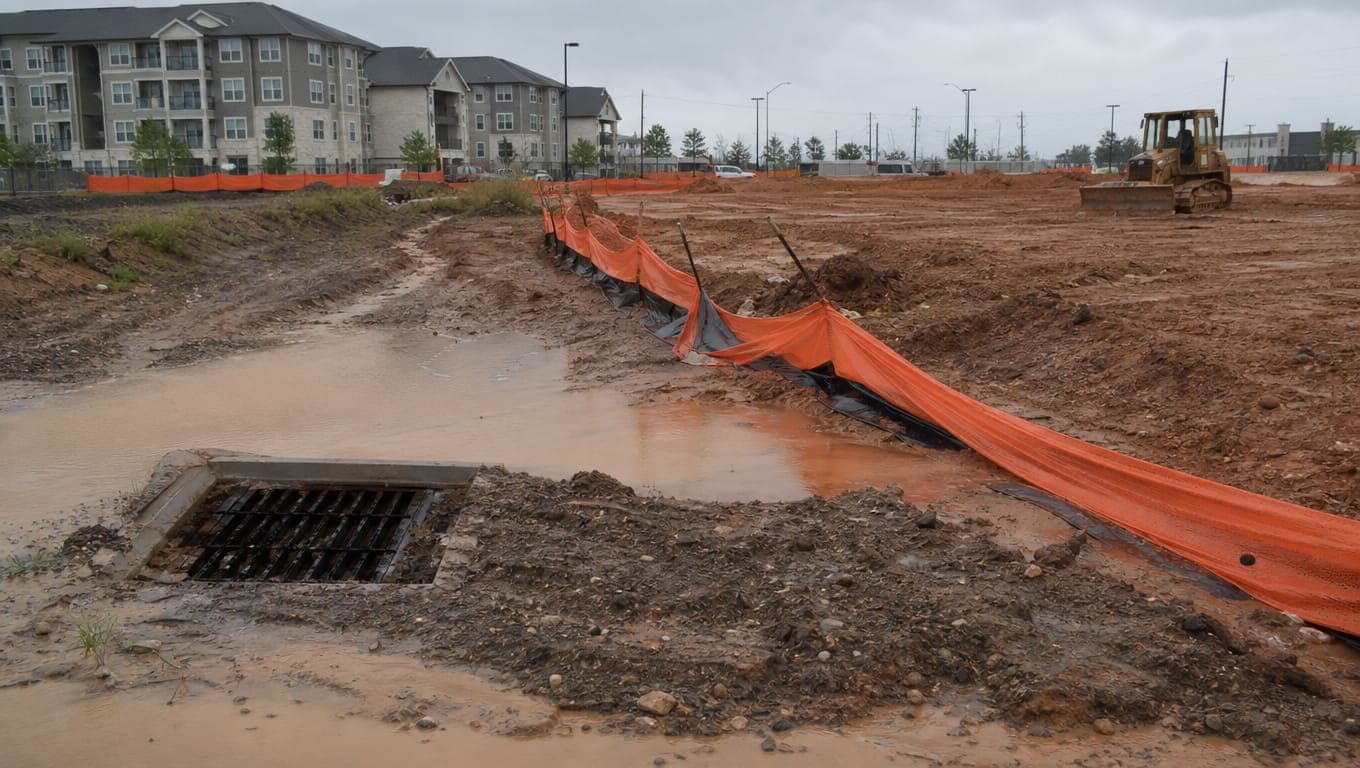
Published October 22, 2026. Last reviewed October 22, 2026. Technical review: Jim Price, CISEC, CESSWI. Founder, Stormwater Compliant LLC.
Correct the deficiency, document the correction with dated photographs, update your SWP3 and corrective action log, then request re-inspection. The speed of the process depends almost entirely on the quality of your evidence package. Do not resume work until the order is lifted.
If your site is shut down right now, call (210) 776-6515. We mobilize emergency BMP crews across the San Antonio metro.
The first hour
Six things, in this order.
- Read the order and identify exactly what was cited. Not the general concern, the specific deficiency. Everything downstream depends on knowing precisely what has to be corrected.
- Stop the work covered by the order. Continuing to work under a stop-work order converts a fixable problem into a serious one.
- Stop the discharge if one is active. If sediment is currently leaving the site, that is the emergency inside the emergency. Sandbags, wattles, whatever is on the truck, right now.
- Photograph the current condition. Before you touch anything. Dated, located, wide shots and close shots. This is your baseline and you cannot recreate it later.
- Identify who is coordinating. One person owns the response and the communication. On a multi-operator site, decide this immediately rather than assuming.
- Get a crew moving. The correction is what ends the shutdown, and every hour before it starts is an hour on the back end.
Then read the rest of this.
What usually triggers one
Most stop-work orders in this market trace to one of five things.
An active discharge. Sediment-laden water leaving the site into a street, a storm inlet, a creek, or neighboring property. The most serious category and the one that gets the fastest response from the agency.
Tracked sediment on public roads. Highly visible, frequently reported by the public, and a reliable indicator of a failed or undersized stabilized construction exit.
Failed or absent perimeter controls, particularly where the failure is discharging or clearly about to.
Construction commenced without required approvals. Over the Edwards Aquifer this is the big one. Under Part II.C.5 of the state construction permit, construction may not commence at a site regulated under 30 TAC Chapter 213 until TCEQ has approved the applicable Water Pollution Abatement Plan or Contributing Zone Plan. Starting before that approval is not a corrective-action situation. See Edwards Aquifer Protection Plans: WPAP and CZP basics.
Repeat findings with no documented response. A site cited for the same item across multiple inspections, with nothing in the record showing it was addressed, escalates. This is the category that surprises people, because each individual finding felt minor.
Knowing which one you are in tells you how the response goes. The first three are physical problems with physical fixes. The fourth is a permitting problem that a crew cannot solve. The fifth is a documentation problem as much as a field one.
The response sequence
Within the first day
- Deficiency identified precisely and understood
- Active discharge stopped
- Baseline photographs taken
- Crew mobilized to correct
- Coordinator identified and communicating with the inspector
As the correction proceeds
- Correct the cited deficiency completely rather than partially. A partial fix at re-inspection costs another cycle.
- Look at the rest of the site while you are at it. If the inspector returns and finds a second problem, you start over. Fix what they would find next.
- Photograph the work in progress, not just the end state.
- If the plan needs to change, amend the SWP3. Where a control is being installed differently from the plan, the plan follows. See SWPPP site maps and BMP sequencing.
Before requesting re-inspection
- Correction complete and verified by someone who knows what the inspector is looking for
- Photo documentation assembled
- Corrective action log updated with dates
- SWP3 amended if applicable
- Any missing documentation cured, including postings and notifications
- Site generally presentable, because the whole site is in scope at re-inspection
After the order is lifted
- Resume work
- Keep the documentation. It matters if there is a next time.
- Fix the process that let it happen
Building the evidence package
This is where the days are won or lost, and it is the part most contractors underinvest in.
An inspector deciding whether to lift an order is deciding whether the problem is genuinely resolved and whether it is likely to recur. Your evidence package answers both.
What a strong package contains:
- Before photographs showing the cited condition, dated and located
- During photographs showing the work being performed. These matter more than people expect, because they demonstrate the correction was actually done rather than the angle being changed.
- After photographs from the same vantage points as the before shots. Same angles. This makes the comparison immediate and unarguable.
- A written description of what was found, what was done, when, and by whom
- The updated corrective action log with completion dates
- The SWP3 amendment, if the plan changed
- Any related documentation that was missing and has now been cured
What a weak package looks like: three photographs from different angles than the original, no dates, and an email saying it has been fixed. That gets a site visit rather than a lifted order, and a site visit takes however long it takes.
Same angles, dated, with a written narrative. It is not complicated and it is worth the extra hour.
Requesting re-inspection
Request through the channel identified on the order, and include the evidence package with the request rather than waiting to be asked for it.
Two suggestions from experience.
Have someone credentialed present for the walkthrough if you can. An inspector asking a technical question and getting a technical answer on the spot resolves things that otherwise become follow-up items. Our inspectors hold CISEC and CESSWI credentials and attend these.
Do not resume work until the order is lifted, confirmed, in writing. Resuming on a verbal impression that things looked fine is a genuinely bad outcome if the understanding was wrong.
We are not going to publish a turnaround time, because SAWS controls that and it varies with the deficiency, the season, and their workload. What you control is whether your package requires a second cycle.
What slows it down
Six things, all avoidable.
Partial correction. Fixing the cited item but not the identical problem thirty feet away.
Poor documentation. Covered above, and the single most common cause of a second cycle.
A second problem found at re-inspection. The whole site is in scope. Walk it yourself first, honestly, and fix what you find.
Arguing rather than correcting. Sometimes an order feels harsh. Litigating that with the inspector while the site sits idle is usually more expensive than correcting and moving on, even when you are right.
Nobody coordinating. On multi-operator sites, three parties each assuming another is handling it loses days. Decide who owns it in the first hour. See multi-operator sites and who holds the liability.
A permitting problem treated as a field problem. If the order stems from commencing without an approved Edwards Aquifer plan, no amount of silt fence resolves it. That needs the approval, and no crew can shorten that path.
Can it be appealed?
There is generally a process for disputing an enforcement action, and if you have a genuine factual disagreement, for example the discharge did not originate from your site, it is worth raising through the proper channel with evidence.
But be realistic about the arithmetic. A dispute takes time during which the site is not producing. Correction usually takes less time than the argument, even when the argument is winnable. On most orders the fastest route back to vertical is to fix it, document it thoroughly, get the order lifted, and then raise any concerns about the finding separately, on your own schedule, with the site running.
Where the order involves a significant penalty or a genuine factual dispute, that is a conversation for your counsel rather than for a blog article, and it should happen in parallel with the correction rather than instead of it.
Preventing the next one
Briefly, because you have a site to reopen.
Almost every stop-work order we see was preceded by a finding that was not fully closed out. The pattern is consistent: something gets cited, it gets physically fixed, nobody documents it, the record shows a repeat finding, and eventually the escalation arrives.
Three things prevent it:
Close out findings in writing. Fix it, photograph it, date it, log it. Half the failures are documentation rather than field condition.
Inspect on the schedule, including after storms. The 14-day and post-storm requirements exist because that is when controls fail. See how often SWPPP inspections are required.
Fix the visible things immediately. Tracked sediment on the public road and a failed perimeter control facing the street are what generate complaints, and complaints generate visits.
Emergency mobilization
We mobilize BMP crews for shut-down sites across San Antonio, Bexar County, Boerne, New Braunfels, and Seguin. Perimeter controls, inlet protection, stabilized exits, stabilization, and whatever else the order names, with the photo documentation package assembled as we go so the re-inspection request goes out complete.
The reason we can move quickly on this is structural. We inspect and we self-perform the repair, so a shut-down site does not have to find a consultant to write the response and separately find a contractor to do the work. That handoff between two vendors is exactly where days disappear.
Call (210) 776-6515. For a shut-down site, call rather than email.
Request a quote for non-urgent work. See BMP maintenance and repair, our 40-point inspection, or the full local picture in San Antonio, Bexar County, and Edwards Aquifer stormwater rules.
Sources
Common questions
- What do I do first after a stop-work order?
- Identify the exact deficiency cited, stop the covered work, stop any active discharge, photograph the current condition before touching anything, and get a crew mobilized.
- How long until I can resume?
- That depends on the deficiency and on SAWS, and we will not guess at it. What you control is the quality and completeness of your correction and evidence package, which is what determines whether one cycle is enough.
- Can I keep working in other areas?
- Only if the order permits it. Read the scope carefully and confirm rather than assume.
- What documentation do they want?
- Before, during, and after photographs from consistent vantage points, dated and located, plus a written description, an updated corrective action log, and any SWP3 amendment.
- Can I appeal?
- There is generally a dispute process, but correction is usually faster than argument. Raise concerns separately once the site is running.
- Who do I call?
- Coordinate with SAWS through the channel on the order. For the field correction, call us at (210) 776-6515.
The work behind this article
- Stormwater Inspection Services
CISEC and CESSWI inspectors, on your site every seven days while the job is live and on your MS4's schedule once it is not. One inspector, one tablet, forty checkpoints, and the report before the truck leaves the property.
- Stormwater Pollution Prevention Plan (SWPPP)
A San Antonio SWPPP company that writes the plan, files the NOI, and walks the binder with your superintendent. Site-specific to your grading plan, written to TXR150000, not a template with somebody else's logo taken off.
- Stormwater Basin and BMP Maintenance
A Texas stormwater maintenance company that runs your basins and ponds on a calendar instead of on emergencies. Mowing, vegetation, sediment, trash racks, and inlets on the scheduled visit, and crews on site within 72 hours when a control is failing between them.
Need help with stormwater compliance on a San Antonio property? We do site walks at no charge.
Request a fixed-price quoteMore field notes from the watershed.
 Compliance · 11 min
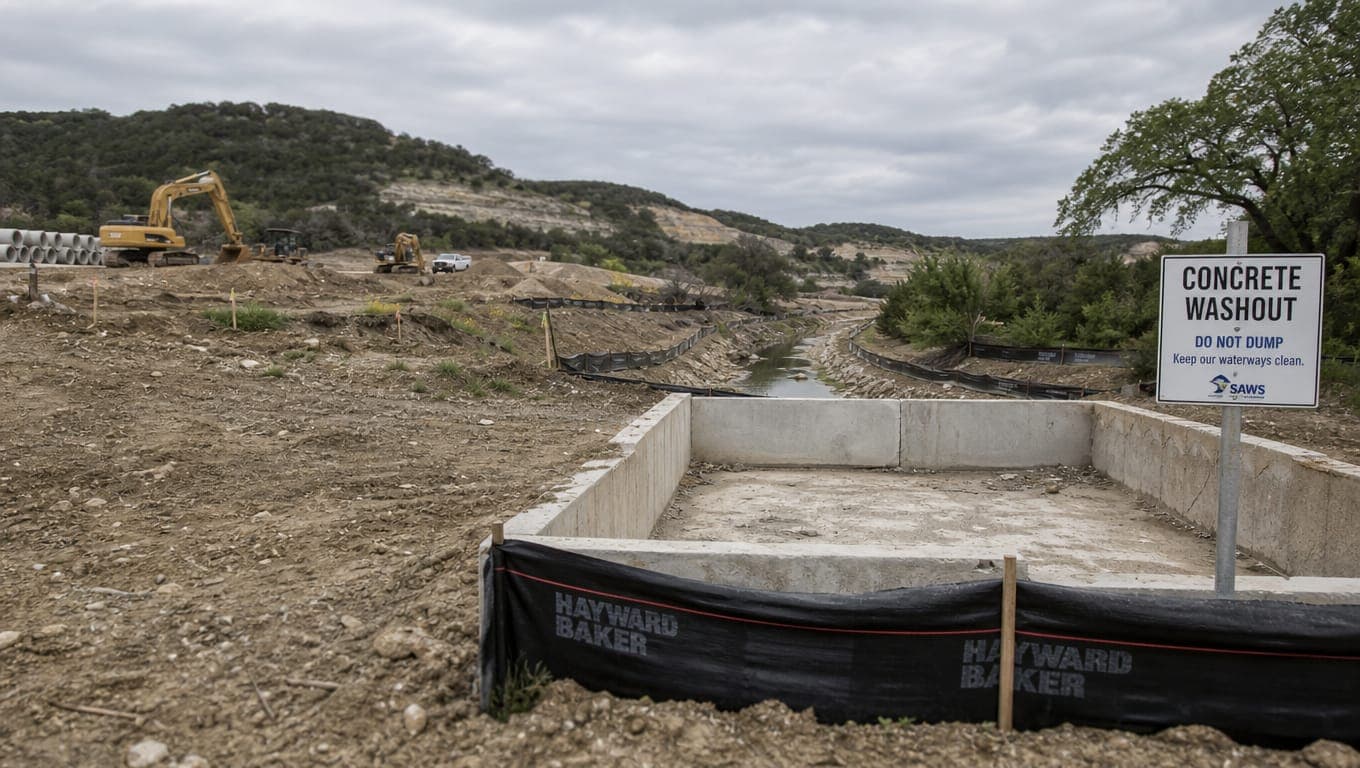
San Antonio, Bexar County, and Edwards Aquifer Stormwater Rules
A San Antonio construction site can sit under five separate stormwater authorities at once: TCEQ for the state permit, TCEQ's Edwards Aquifer Protection Program for the aquifer overlay, SAWS and the City of San Antonio inside city limits, and Bexar County Public Works in the unincorporated area
 Field guide · 8 min
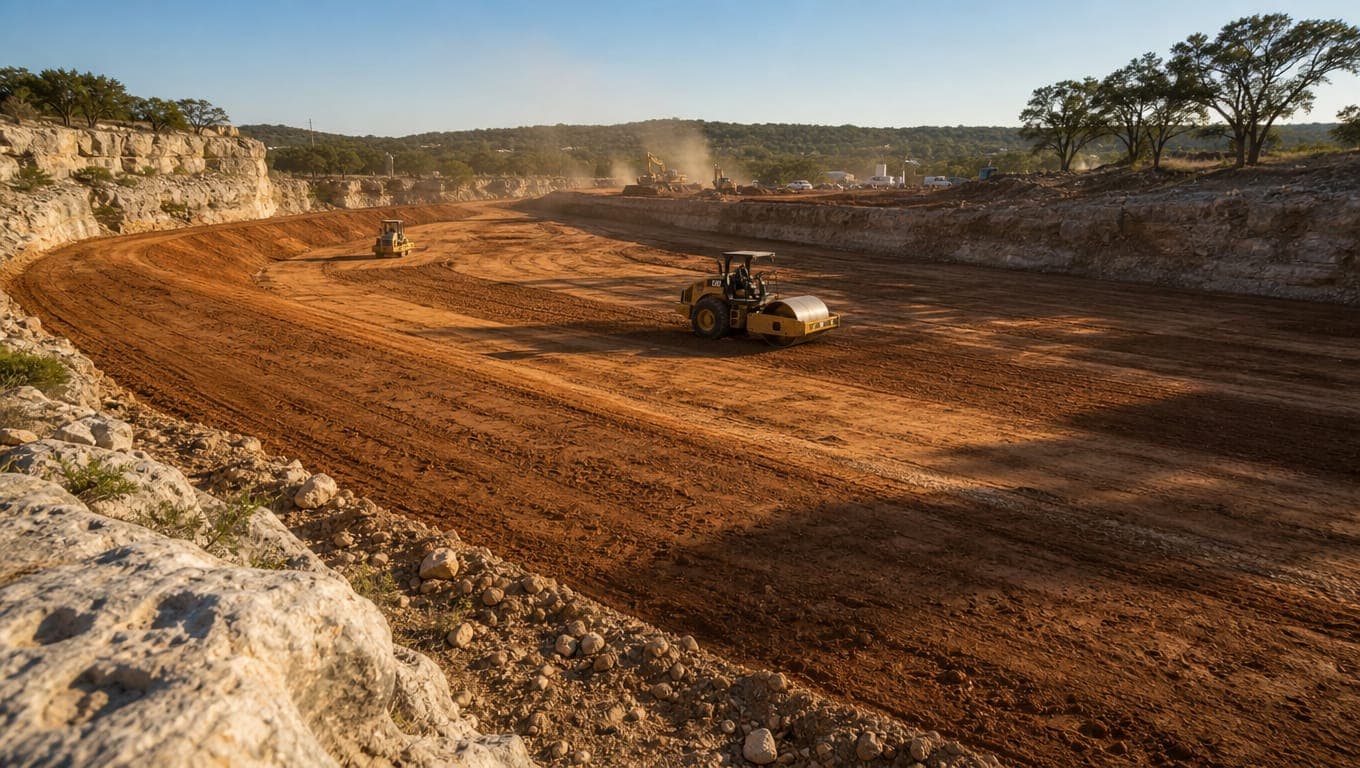
Basin Lining Requirements Over the Recharge Zone
Water quality basins over the Edwards Aquifer Recharge Zone require impermeable liners. TCEQ's technical guidance, RG-348, allows clay, concrete, or geomembrane. A clay liner needs a minimum thickness of 12 inches and a permeability of 1 x 10⁻⁶ cm/sec. A geomembrane needs a minimum thickness of 30
Get a stormwater
compliance quote.
Free site walk, written scope of work, fixed-price quote. Usually back to you within 48 hours.